


SRC Releases Policy Document: Trading Our Way to Recovery During COVID-19: Recommendations for CARICOM Countries
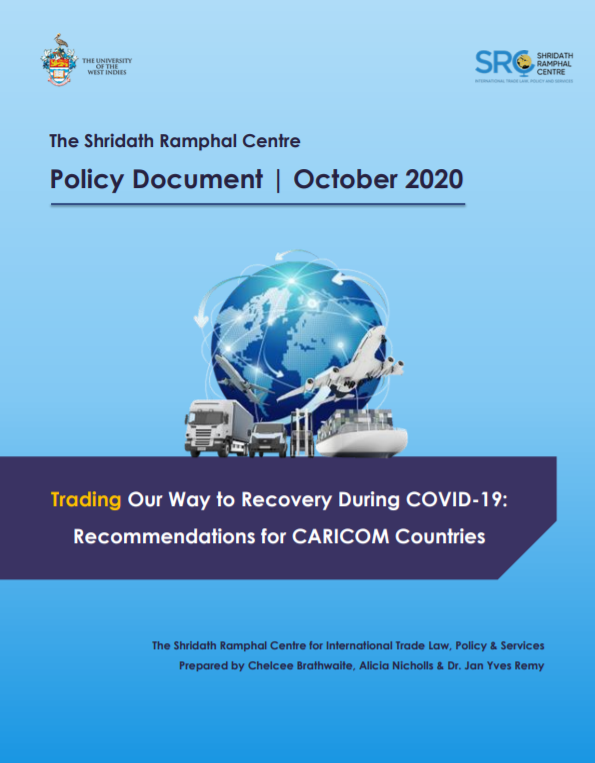
We are excited to share with you our SRC Policy Document entitled “Trading Our Way to Recovery During COVID-19: Recommendations for CARICOM Countries” which is available here. The Policy Document was written by the SRC Research Team comprising, Chelcee Brathwaite, Alicia Nicholls and Jan Yves Remy and was peer-reviewed by a number of subject-matter experts in the topics covered by the Document. The SRC Policy Document provides a comprehensive review of the region’s economic shortcomings exposed by COVID-19 and the role that trade policy can and should play in its economic recovery. After providing an overview of CARICOM’s economic, investment and trade profiles (Chapter 1), the Policy Document looks at five main sectors that we deem critical for the region’s sustainable development. Each Chapter looks at the sector pre-COVID-19, summarizes the impact the pandemic has had on it, and then provides SRC Recommendations on how trade policy can provide solutions and answers to overcome the shortcomings exposed. Specifically, the Chapters are are organized as follows: Chapter 2: Innovation & Industrial Policy: Against the backdrop of ‘hyper-globalization’, free trade and the fourth industrial revolution, rethinking industrial policy is imperative. How then can the region adopt an innovative posture in its approach towards industrial policy? Chapter 3: Agricultural Development & Food Security: Can the region mobilize the Community Agricultural Policy outlined in the Revised Treaty of Chaguaramas in order to transform its agricultural sector, improve the state of food security and reduce the vulnerability level caused by excessive external dependence? Chapter 4: E-Commerce: With the COVID-19 pandemic forcing us to embrace e-commerce and the wider digital economy, how can the region better position itself to reap the benefits from this virtual transition? Chapter 5: MSME Development & Export Activity: Across CARICOM, micro, small and medium sized enterprises (MSMEs) constitute the majority of businesses and contribute significantly to regional employment. However, during the COVID-19 pandemic MSMEs have been severely impacted. We offer an export-oriented roadmap for revitalising the region’s MSMEs. Chapter 6: Investment Facilitation: Caribbean countries will require foreign capital to assist in their economic recovery efforts. How then can the region promote and facilitate sustainable investment going forward to aid its recovery? We will be releasing individual Chapters in the coming weeks as SRC Policy Briefs.
Panel on ‘Current Trade Policy Issues in the Caribbean Region’
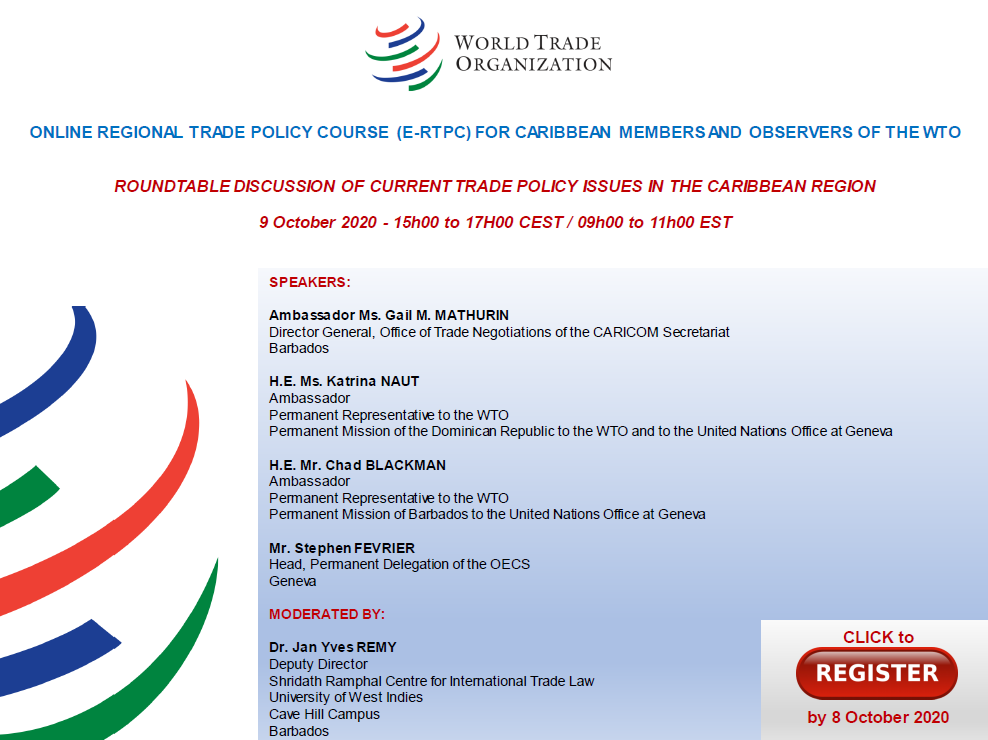
The World Trade Organization launched on 10 August 2020 its first online Regional Trade Policy Course (e-RTPC) for Caribbean Members and Observers. The e-RTPC has been organized by the Regional Trade Policy Course Unit of the Institute for Training and Technical Cooperation (ITTC) of the WTO. Twenty government officials from ten Caribbean Members of the WTO are attending the e-RTPC that will end 13 November 2020. The objectives of the e-RTPC are to: 1) deepen understanding of the WTO Agreements and the functioning of the WTO, its rules and procedures; 2) strengthen capacity to access WTO information resources and the ability to find relevant provisions in the WTO legal texts; and 3) enhance understanding of relevant trade policy issues in their regional context. As a contribution to the third objective a panel of distinguished trade policy experts from the Caribbean region will share in a roundtable discussion their views on current trade policy issues in the Caribbean region. The roundtable discussion will be moderated and include a questions and answers session. The event is scheduled on Friday 9 October from 15:00 to 17:00 Central European Summer Time (CEST) / 09:00 to 11:00 Eastern Standard Time (EST). To register, please click on the link here.
From Vulnerability to Resilience Using a Trade Vulnerability Index – Geneva Trade Week, S48 – RECORDING
On Friday, October 2, 2020, the SRC hosted a session for Geneva Trade Week that extends our work on a Trade Vulnerability Index (TVI) that can be deployed in trade negotiations to help WTO countries overcome their vulnerabilities and work towards resilient outcomes. Our international slate of panelists discussed the concrete possibilities for using the TVI at the WTO. They were: Dr. Travis Mitchell – Economist, Commonwealth Secretariat Mr. Jason Cotton – Economist, Caribbean Development Bank Dr. Hannes Schloeman – WTI Advisor, Trade Policy/Law Advisor Dr. Patrick Low – Independent Consultant/Economist The event was moderated by Dr. Jan Yves Remy, our Deputy Director. Barbados’ Prime Minister Mia Mottley has called for such a Vulnerability Index in her recent interview with CNN’s Christiane Amanpour which you can watch here. The recording from the event can be watched here:
SRC High Level Webinar ‘Towards a Caribbean Trade Strategy’ – RECORDING HERE!
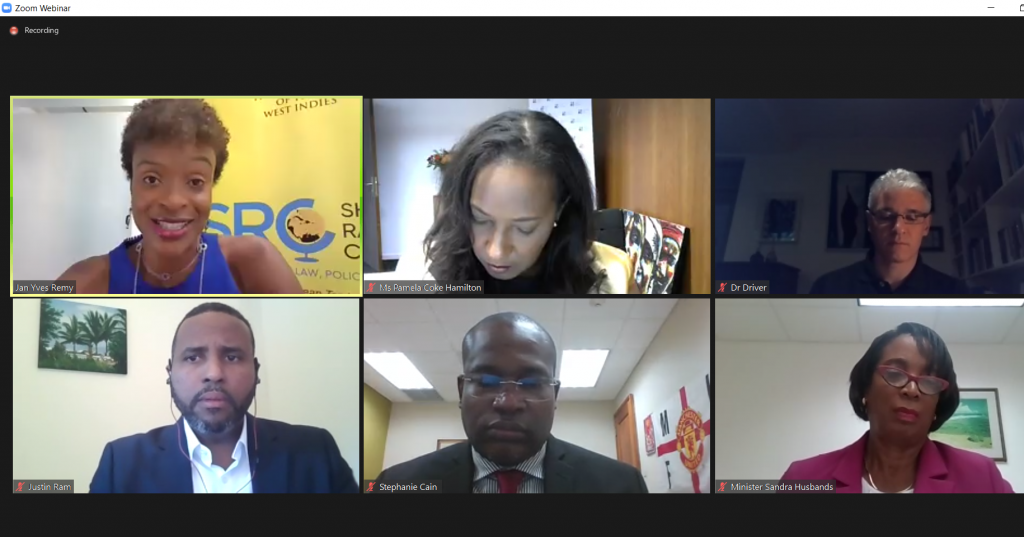
On October 9, the SRC hosted a High-Level Webinar entitled “Towards a Caribbean Trade Strategy”. The esteemed panel of speakers comprised: Hon Sandra Husbands, MP – Minister in Ministry of Foreign Trade, BarbadosPam Coke Hamilton – Executive Director, ITCProfessor Densil Williams – Prof of International Business, UWIDr. Justin Ram – Consultant Economist, CEO of GSECDr. Dax Driver – Chairman of CARICHAM The event was moderated by the SRC’s Deputy Director, Dr. Jan Yves Remy. Watch the video recording from the webinar here:
In Its Race For Director-General, Will The WTO Make History Or Her-Story?

In Its Race For Director-General, Will The WTO Make History Or Her-Story? Author: By Leah Crag-Chaderton & Nicholas Lazarus Just three weeks after Roberto Azevedo officially demitted office as Director-General (DG) of the World Trade Organization (WTO), the selection process for his successor is well under way. The list of those vying for the helm of the WTO got shorter on September 18th, when the General Council revealed Ngozi Okonjo-Iweala (Nigeria), Yoo Myung-hee (Republic of Korea), Amina C Mohamed (Kenya), Mohammad Maziad Al-Tuwaijri (Saudi Arabia) and Liam Fox (United Kingdom) as the final candidates for the coveted DG position. While these five remaining candidates are all exceptionally qualified professionally, this SRC Trading Thoughts SRC Trading Thoughts September 28, 2020 Just three weeks after Roberto Azevedo officially demitted office as Director-General (DG) of the World Trade Organization (WTO), the selection process for his successor is well under way. The list of those vying for the helm of the WTO got shorter on September 18th, when the General Council revealed Ngozi Okonjo-Iweala (Nigeria), Yoo Myung-hee (Republic of Korea), Amina C Mohamed (Kenya), Mohammad Maziad Al-Tuwaijri (Saudi Arabia) and Liam Fox (United Kingdom) as the final candidates for the coveted DG position. While these five remaining candidates are all exceptionally qualified professionally, this SRC Trading Thoughts will examine which of those qualifications might be best suited for the DG position. But first, the diversity of the individuals demands some attention. It is noteworthy that all three of the women who entered the race have progressed to the second round, and two of them hail from the African continent. This signals a bold move as the success of either one would mean the appointment of not only the first African DG, but also the first female. While female leadership and geographic representation are important, equally important is making the best choice for the job given the plethora of challenges that has plagued the WTO in recent times. Director General Roberto Azevedo resigned one year early. The WTO’s Appellate Body does not have enough members to hear appeals against decisions of panels that preside over disputes between member states because the United States is blocking the appointment of new members. There is an ongoing trade war between the United States and China, the world’s two largest economies. This is all before factoring in the unparalleled economic impact of the Coronavirus pandemic. Fox, a Brexit supporter and the first United Kingdom (UK) Secretary of State for International Trade promises reform if he is selected as DG. His contention that WTO disputes can be better resolved if dealt with first on a national level seems counterintuitive to the purpose of the WTO’s dispute mechanism. A seasoned conservative politician and former Minister under Prime Minister Theresa May, he has stated openly that, if selected as DG, half of his senior advisors will be women. His stance against Huawei’s participation in the UK’s 5G network and sanctimonious remarks on China’s handling of the initial outbreak of COVID-19 might make him an unpopular choice in Beijing. Given that the WTO has never had a female or African Director-General, and the current global movements for equity and economic justice, Fox may be too traditional a candidate to ultimately be selected. Additionally, the situation requires innovative and bold leadership and perhaps a conservative may not be the right fit. Although the two African women are attracting much attention, the 53-year old South Korean Myung-hee may be the one to watch in this race. Presently serving as the country’s Minister of Trade, she brings a wealth of relevant experience to the table having worked in the field for over a quarter century. But is trade knowledge all it takes to run the WTO? Myung-hee should certainly possess the diplomatic experience navigating the tensions between South Korea’s traditional American allies and the rising regional power of China. In addition, her work in the Asia-Pacific Economic Cooperation (APEC) makes her familiar with multilateral economic fora. While these are strengths in Myung-hee’s favour, South Korea has its own trade issues with neighbouring Japan, the world’s third largest economy, that may pose a threat to her emerging as the top pick. Al-Tuwaijri’s background is much less typical for that of the Director General. He is by far the most unconventional, and unlikely candidate. As a former Minister of Economy and Planning, he played a crucial role in the reform of the Kingdom’s economy, promoting trade with an emphasis on the private sector small to medium enterprises and utilizing international best practices to attain sustainable economic prosperity. With his background in banking, he brings financial management and planning skills which given the WTO’s reduced budget, could be just what is needed at the reins. In an interview in August 2020 with Chatham House, he described the ideal DG candidate as a hybrid candidate possessing trade experience (understanding the WTO) but also having political experience. He also emphasized the need for accountability in the DG position and claims that he can bring this, along with consistency of delivery to the post. Ironically, he lacks the very trade experience that he deems essential. Amina Chawahir Mohamed Jibri is a lawyer, diplomat, and politician. With this trifecta of qualifications, it is no surprise that she is favoured to go through as one of the final two candidates once the second round of the selection process concludes in early October 2020. A lady of many firsts, particularly in the WTO context (first African to chair a trade negotiation round of the WTO and female chair of the governing General Council of the WTO), becoming the first female and first African DG of the WTO seems like a natural progression for the Kenyan contender. In an article in The African Report, Ambassador Mohammed has expressed concern for the credibility of the WTO, stating that reform is a necessity. She will be hoping to avoid a repeat of her unsuccessful bid for African Union Commission Chair in 2017, a campaign that hinged on
Join the SRC at Geneva Trade Week!
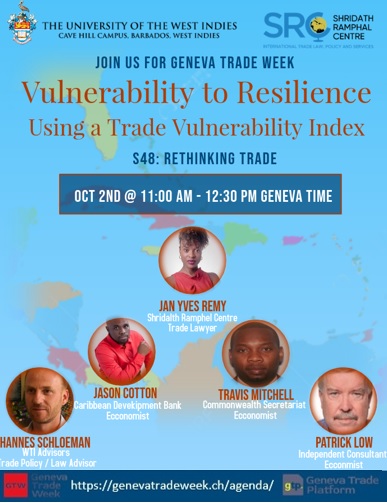
The SRC is hosting a session for Geneva Trade Week that extends our work on a Trade Vulnerability Index (TVI) that can be deployed in trade negotiations to help WTO countries overcome their vulnerabilities and work towards resilient outcomes. Join our international slate of panellists as we debate the concrete possibilities for using the TVI at the WTO. Prime Minister Mia Mottley has called for such a Vulnerability Index in her recent interview with CNN’s Christiane Amanpour https://youtu.be/tT-iuDmRbgI Please see further details in flyer above.
Dispute Settlement at the WTO: How Did We Get Here and What’s Next for Commonwealth States?

Our Deputy Director Dr. Jan Yves Remy authored an article in the latest edition of the Commonwealth Secretariat’s Trade Hot Topics entitled “Dispute Settlement at the WTO: How did we get here and what’s next for Commonwealth States?”. The piece looks at dispute settlement at the WTO and proposals for overcoming the current Appellate Body crisis. It also considers consequences for Commonwealth States. Have a read of the article here.
WTO issues call for papers for new Trade Economist Thematic Award
Are you completing (or already have) a PhD/Master’s degree in a developing country?The WTO has issued a call for papers for the new WTO Trade Economist Thematic Award. Trade experts at universities in developing countries are invited to submit case studies on the impact of the COVID-19 pandemic on trade and trade policy. The winning paper will be rewarded with a prize of CHF 5,000. Papers must be submitted by 30 September 2020. Learn more here.
COVID-19: An Opportunity to Rethink Caribbean Diaspora Engagement
David Gomez and Alicia Nicholls$*Caribbean economies, like others around the world, have been negatively impacted by the on-going novel coronavirus disease 2019 (COVID-19) pandemic. The International Monetary Fund (IMF) in its June 2020 Economic Outlook forecasts global gross domestic product (GDP) growth at – 4.9 percent in 2020. For tourism-dependent economies like Barbados, the Bahamas and Jamaica, the Inter-American Development Bank (IDB) predicts a double-digit contraction in economic activity.
New UNCTAD 15 date as website launched
Nation News: The United Nations Conference on Trade and Development (UNCTAD), to be held in Barbados, has been rescheduled for April 25 to 30, next year. The new date was announced by national co-ordinator for UNCTAD 15, Teresa Marshall at the official launch of the conference website yesterday morning. She said the site was intended to profile Barbados and would provide “comprehensive information for delegates attending the conference”. Marshall also said the website would highlight the priorities Barbados and the Caribbean wished to see addressed at the meeting, as well as inform Barbadians about the conference and the economic opportunities it can provide. Read the full article on Nation News here.