


The Next WTO Director-General: Ngozi Okonjo-Iweala’s Long Walk to Victory

Leah Crag-Chaderton & Nicholas Lazarus$*On October 28th 2020, at a Heads of Delegations (HOD) meeting, Ambassador David Walker recommended that Ngozi Okonjo-Iweala be appointed as the new Director-General (DG) of the World Trade Organization (WTO) following the conclusion of the third and final individual consultations with Member State delegations on October 27th…
The sun rises in the East

Joel K. Richards In geopolitics today, as it occurs in nature, the sun rises in the East. Here, I am specifically referring to the East-Asia region which is now one of the most dynamic regions of the world in terms of economic growth, technology and innovation. Recently, on 15th November 2020, this region sent a signal of its growing strength to the rest of the world by concluding eight years of tough negotiations for a Regional Comprehensive Economic Partnership (RCEP) Agreement. RCEP is now the world’s biggest trade deal and it involves 15 economies, including members of the Association of South-East Asian Nations (ASEAN), Australia, China, Japan, New Zealand and South Korea. By comparison, RCEP is bigger than both the European Union (EU) and the United States (US)-Mexico-Canada Trade Agreement. Currently, based on a report by the British Broadcasting Corporation (BBC), members of RCEP comprise almost one-third of the world’s population and make up for roughly 29% of global gross domestic product (GDP). The British multinational investment bank HSBC predicts that by 2030, RCEP could account for 50 percent of global output. Furthermore, the Peterson Institute for International Economics estimates that RCEP has the potential to increase global national income by USD$186bn annually by 2030 and add 0.2% to the economy of its member states. Because China is part of RCEP, some observers see the agreement as a major geopolitical victory for Beijing, especially when considering that the US pulled out of the Trans-Pacific Partnership (TPP) when President Trump assumed office. We should recall that the TPP formed part of the Obama Administration’s pivot to Asia, a move interpreted as countering China’s influence in that region. RCEP may indeed turn out to serve China’s interests. However, it would be wrong to assume that the deal is primarily about China. Peter Petri of the Peterson Institute and Michael Plummer of Johns Hopkins University estimate that Japan and South Korea will gain the most because by 2030, their real incomes are expected to be 1% higher than they would have otherwise been. RCEP is further evidence of Asia’s growing power, especially at a time when the corresponding power and influence of the EU and the US appear to be on the decline. In a research note, economists at HSBC have stated that RCEP “may reinforce a trend that’s been already underway for decades: that the global center of economic gravity keeps pushing relentlessly to the East.” This idea that the global center of economic gravity keeps shifting to the East is particularly important for small developing states in the Caribbean which continue to rely heavily on North America and the EU for trade and investment. Of course, there are historical ties with Europe as well as proximity when it comes to North America which suggest that total decoupling is unlikely to ever take place. In any case, total decoupling should not be the goal. Nonetheless, Asia’s economic dynamism and its excellence in areas such as innovation and technology mark it out as an ideal region with which to develop strong economic and diplomatic ties. It is also important to emphasize that Asia is more than just China. Singapore for example has emerged over the years as one of the world’s most advanced economies, notwithstanding its relatively small size. Singapore has world class logistics, financial services, business facilitation services and transport engineering services among other competitive advantages. South Korea is another of Asia’s success stories and it has experienced one of the largest economic transformations in modern times, with specific strengths in technology development and innovation. For its part, Japan has the world’s third largest economy, a high capacity for innovation and technology, and thousands of cash-rich businesses. These are all strengths that can be tapped into by Caribbean countries through diplomacy and economic cooperation arrangements to the extent that the political will exists to bring about the desired outcomes. Finally, the notion that the sun is rising in the East should not suggest that it has set in the West, at least in a geopolitical sense. The West, mainly the US, Canada and the EU will continue to occupy an important role both globally and in the Caribbean region. However, as Asia continues on an upward trajectory, this calls for more engagement between the Caribbean and Asia with a view to enhance trade, investment, technology and innovation, especially for the benefit of Caribbean economies and societies. Joel K. Richards is a national of St. Vincent and the Grenadines. He previously worked as an Advisor to the CARICOM Secretariat and the principal trade consultant to the Barbados Private Sector Association. He is currently based in Europe where he works in the field of international trade and development.
Unlocking the Full Potential of the Association of Caribbean States
Dr. Jan Yves Remy and Chelcee Brathwaite$*The signing of the Convention Establishing the Association of Caribbean States (ACS) on 24 July 1994 in Cartagena de Indias, Colombia, signalled a new era of regional cooperation, one envisaged in the 1980s when CARICOM indicated its desire to widen the integration process to include all other countries in the Caribbean Basin. Against the backdrop of furthering cooperation…
ILA Webinar on Caribbean’s Contribution to the Development of International Law – November 18, 2020

One of the objects of the Caribbean Branch of the International Law Association (ILA Caribbean Branch) is to promote understanding and the progressive development of international law in the Caribbean. As its first outreach activity, the new Executive of the Branch is convening a panel discussion on November 18, 2020 to explore the involvement of the Caribbean in the development of international law. The Faculty of Law, UWI, Cave Hill has endorsed and is providing support to the event. View the flyer below to see the expert panelists: The objectives of the panel discussion are to: a) highlight the ways in which the Caribbean has been at the forefront of the development of international law, for example, through participation in treaty-making and the work of international tribunals and international bodies such as the International Law Commission; b) spotlight the Region’s influence on the development of various fields of international law, such as the law of the sea, human rights and climate change; c) stimulate discussion on the importance of the Region remaining an active participant in the development of international law. The registration link is as follows: https://zoom.us/webinar/register/WN_wYmyr2jKQ4S3yAPMJEJ9dg
Webinar on Port Community System and Electronic Single Window to Improve Trade and Business Facilitation in Barbados
Download flyer below for further details
BIBA – Global Business Week 2020: New Opportunities in Global Trade to and from Barbados Panel
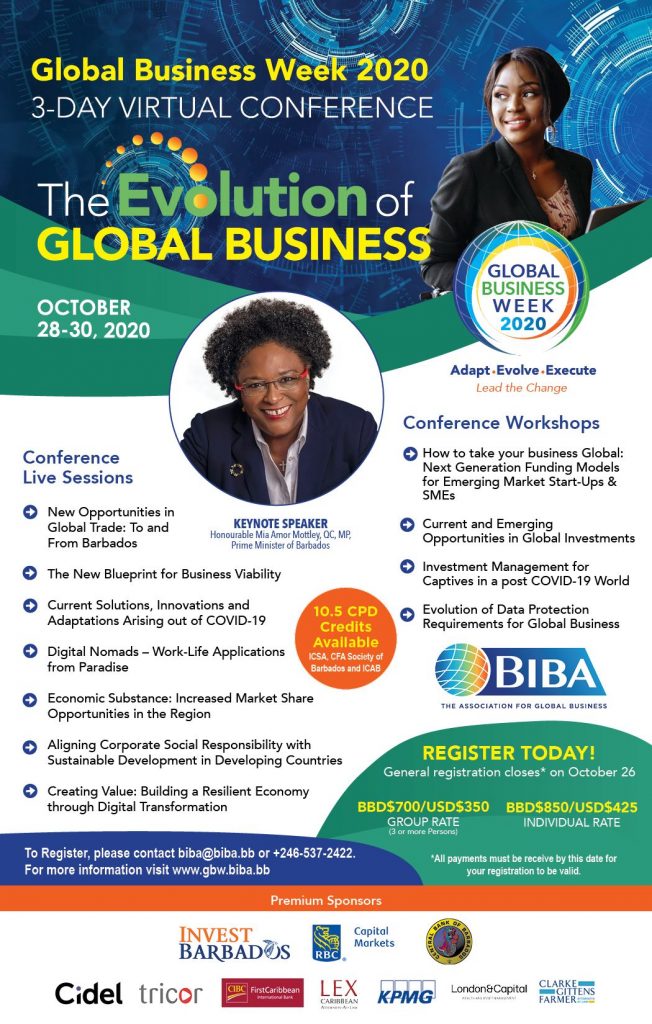
International trade, the outlook for global business development, and strengthening economic environments in a post-COVID-19 world will be among the topics of discussion at the upcoming inaugural Global Business Week 2020 (GBW 2020) Conference, from October 28-30, 2020 hosted by the Barbados International Business Association (BIBA), SRC Deputy Director, Dr. Jan Yves Remy, will moderate the panel entitled “New Opportunities in Global Trade to and from Barbados“. Other panelists include: Matthew Wilson, Chief of Staff to the Executive Director of the International Trade Centre and SRC Advisory Board Member Rupa Ganguli, Founder and CEO, Inclusive Trade Ltd. Alicia Nicholls, Trade Researcher, SRC See the promotional slideshow for the panel here: To learn more and to register, visit the Conference website here.
Reconsidering Strategic Trade Alliances for the Caribbean
Shineco Sutherland$*Caribbean news was recently abuzz with Barbados’ plan to remove the Queen as its Head of State, which would signal a severing of some of the last vestiges of its legislative colonial ties. In the aftermath of that announcement, some of the media in the Global North pounced on China as the instigator of this change, suggesting thereby that our own Caribbean leaders could not themselves be credited…
UWI-EUI E-Dialogue on “COVID-19 and Trade – Sharing the Experiences of the Caribbean and Europe” – Thursday, October 29, 2020

Join The UWI and EUI in their first partner e-dialogue on ‘#COVID-19 and Trade – Sharing theExperiences of the Caribbean and Europe’.Speakers:H.E. Joy-Ann Skinner, Ambassador of Barbados to the EUBernard Hoekman, Dean of External Relations, European University InstituteFelipe De La Mota, EU Delegation in Barbados and the Eastern CaribbeanDon Marshall, Director and Senior Research Fellow, Sir Arthur Lewis Institute of Social and Economic Studies, The University of the West IndiesWatch live➤www.facebook.com/UWITV/
UNCTAD-SRC Webinar on International Investment Agreement Reform in the Caribbean and COVID-19 – WEDNESDAY!
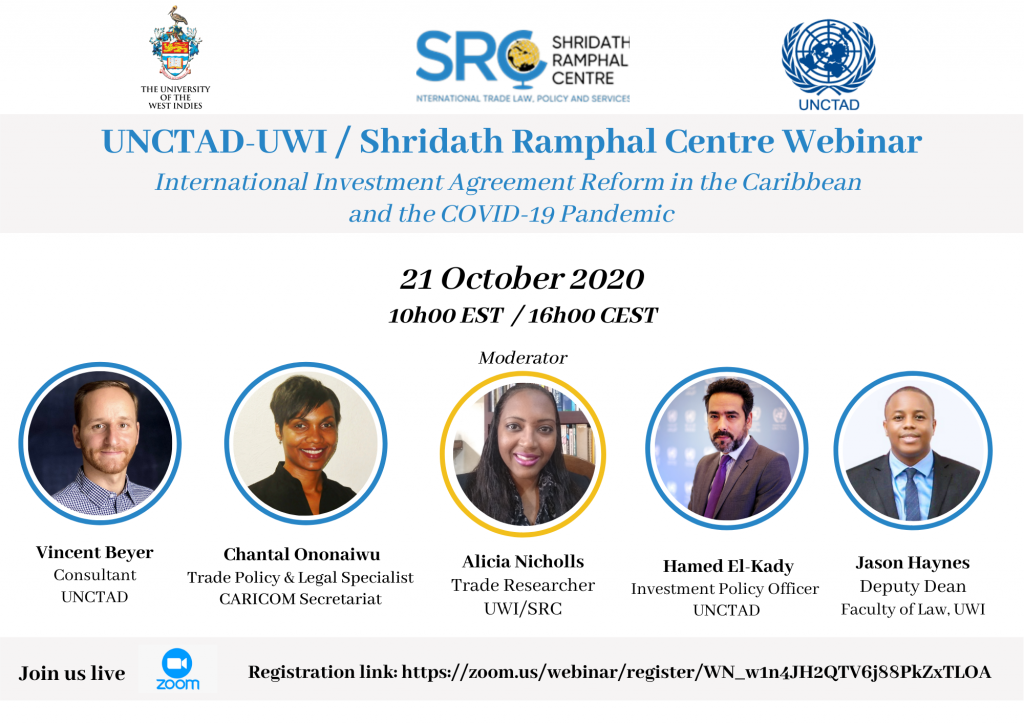
Join us this Wednesday, October 21, 2020 at 10:00 am (Barbados Time/US Eastern Standard Time), 4:00 pm (Central European Standard Time) for our UNCTAD-SRC co-hosted Webinar entitled ‘International Investment Agreement Reform (IIA) in the Caribbean and the COVID-19 Pandemic’. What have been the latest developments in IIA reform globally and in the Caribbean? What has been the impact of COVID-19 on IIA reform? How big is the risk of Investor-State Dispute Settlement (ISDS) claims emanating from Governments’ COVID-19 responses? These are just some of the issues on which our esteemed panel of international and Caribbean investment law and policy experts will share their insights and recommendations. To pre-register Register in advance for the Webinar by clicking the Zoom link here: https://zoom.us/webinar/register/WN_w1n4JH2QTV6j88PkZxTLOA Please see the flyer above for further details. We look forward to you joining us!
Who will deliver the structural changes the pandemic has highlighted?
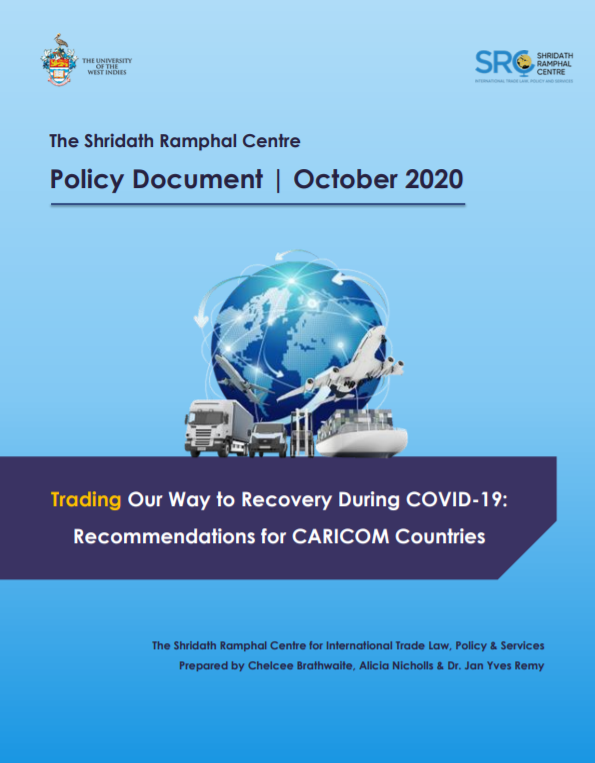
The SRC’s recently released Policy Brief entitled “Trading Our Way to Recovery During COVID-19: Recommendations for CARICOM Countries” was discussed by noted commentator on Caribbean issues, David Jessop, in his latest article. In the piece entitled “Who will deliver the structural changes the pandemic has highlighted?”, Mr. Jessop argued that: The document is at one and the same time, both stimulating and disheartening. It is positive in that it clearly describes the principal long standing economic policy issues holding back the region’s development and suggests several new initiatives that might be pursed. By placing them all in a post COVID recovery context the report effectively challenges governments and the private sector to address each of its forty-four policy recommendations as a part of a coherent deliverable recovery package.It is disheartening because much of what it says should have been addressed decades ago when the region’s financial capacity and the will to deliver regional solutions was much greater. Read the full article here.