


SRC Newsletter for July 2021 now out!

Welcome to the July 2021 edition of our monthly SRC Newsletter! This will be our last newsletter until September when the new semester begins. We bid a sad but fond farewell to our outgoing SRC Director, Neil C.A. Paul who retired from the UWI at the end of July. He has been succeeded by Dr. Jan Yves Remy, who has served as Deputy Director since 2018. Catch up on all the things we have done over the past month and this month’s upcoming events in this edition! Read the newsletter here.
SRC welcomes new Director Dr. Jan Yves Remy

The SRC is pleased to announce the appointment of our new Director Dr. Jan Yves Remy. Dr. Remy joined the SRC as Deputy Director in August 2018. She was appointed Director effective August 1, 2021 and succeeds Neil C.A. Paul who retired on July 31, 2021. You can read Neil’s reflections on his tenure here. Dr. Remy is an attorney-at-law and brings to the post of SRC director some two decades of experience and expertise in international trade law and policy, including working as a dispute settlement lawyer at the World Trade Organisation and as a senior associate at globally renowned law firm Sidley Austin. Early in her career, she had also worked at the Caribbean Regional Negotiating Machinery (CRNM), the predecessor of the Office of Trade Negotiations (OTN) of the CARICOM Secretariat. Welcome Dr. Remy! Learn more about our new Director here!
Some reflections as I move into retirement – Neil C.A. Paul, outgoing SRC Director

Neil C.A. Paul As I move into another phase of my life, I am frequently asked to consider the road travelled during my sojourn and perhaps to offer my own glimpses into the future. Well, I am no soothsayer, and any attempt to see into the future is probably vainglorious, arrogant even. I do however, humbly offer some reflections of my journey for what they are worth. My intention is not to offend but rather to link into the conversation and perhaps create some further food for thought. THE ROLE OF A UNIVERSITY AND ITS ACADEMICS The first reflection concerns the role of the university and its academics in the development of the Caribbean civilization. I have pondered this question for some time now, and while it is commendable to produce scholarly work, published in academic journals, I think this falls short of real impact. Scholarly articles and peer reviewed journal articles are mostly cited by other scholars and academics and hardly seem to contribute to development of our civilization. Perhaps they have in some cases, but I contend that they are far from enough. Two issues should be considered here. Firstly, one of the metrics used for promotion of academics is publication in peer reviewed journals and is therefore, important in the career of the academic. Secondly, these articles remain the purview of other academics and hardly feature in areas of national development, as they should, unless specifically commissioned for that purpose. The question is what can be done to improve the contribution and value of the important scholarly work of our academics, towards the development of our civilization. I think that one of the metrics for promotion should be the extension and communication of the results, research findings and recommendations to the relevant stakeholders through various means, such as seminars, or webinars. If one believes that the research done is important and provides recommended solutions and suggestions which will make a positive impact, then these solutions should be shared with the stakeholders so that they can contribute to the development of our civilization. THE NEED FOR GREATER ACADEMIC MENTORING The other concern of note is the mentoring of younger academics and students in the research process. It appears that there is a competition among academics to publish and as such there is not the sharing and mentorship evident in other similar Universities. This criticism is based on fact that there are very few multiple author peer reviewed publications from Cave Hill. Where they do exist, it is mostly co-authorship and single authorship rather than multiple authorships where senior academics are in fact guiding their younger peers through the treacherous waters of academic publishing. Many academics, depending on the field of expertise, are in a sense forced to research areas which are not relevant to the development of our civilization, primarily because the Journals and other publications set that agenda. Where Caribbean journals exist they are treated in the University as inferior (second and even third tier) to the more established publications so that our academics instead use other preferred outlets. We must develop the cultural confidence to ensure that we treat our own indigenous publications with respect. The concept of mindfulness is also a necessary ingredient in any organization involving people. It is important to treat people as you would treat your family, with love. Here I am speaking about the universal love of brotherhood and sisterhood. People give much of themselves in a caring environment. The arrogance of treating students like they don’t matter has no place in a university. More so, the treatment meted out to staff who are considered by some to be not their equals, is also reprehensible. This is particularly true among some academics and the way they treat non-academic and administrative staff. People remember you for how you treated them and how you made them feel, rather than for your academic qualifications and accolades. In my time, I have heard people remark that you don’t have to like someone or be friends to work with them or other similar comments. While this may indeed be true in some measure, and in some societies, people work much better when they like their peers. The problem with the view that you don’t need to like or be liked to work well, is that it is rooted in a culture of individualism without the empathy of the collective village community ethos. As such it does not quite fit into the paradigm of the evolving Caribbean civilization which is based on the village and its antecedents of the ways in which we live. This is exactly why we have lost our way and adopted these platitudes of the North American and to an extent the contemporary European civilizations with their ills of racism, individual privilege and the destructive capitalist ethic, which by the way is slowly imploding. FOOD SECURITY Another important reflection pertains to Food Security in the Caribbean. The data suggest that CARICOM countries import in excess of US$5 billion in food annually. There was a time when governments invested in the agricultural sector, and as such we produced much of what we ate. As I argued in an SRC Trading Thoughts on this matter, trade liberalization and the end of trade preferences for commodities such as bananas, laid waste to the agricultural sector as we know it.It seems to me that the Caribbean needs to make a decision about the agricultural sector. Do we want to produce what we eat or do we want to be exporting agricultural products? It may well seem that we can indeed do both, however, we must first develop the sector before getting into export. It seems pointless to be involved in exporting to earn foreign exchange, and then turn around and import food with said foreign exchange. We must also stop talking about developing the agriculture sector and do the work of implementing the solutions to food security, which we know only too well. I am aware
NEW SRC Trade Quick Guide – Food Security and Trade!

This latest SRC Trade Quick Guide provides an introduction to food security, its strategic importance, and the state of food security across CARICOM. This Quick Guide has been developed from the SRC Food For Thought Policy Brief Series Part 1: An Overview of Food Security and Trade Across CARICOM authored by our SRC trade researcher Chelcee Brathwaite. Access the Quick Guide here.
Scholarship Applications Open to OECS Nationals

Applications are now open for the OECS-Masters in International Trade Policy (OECS-MITP) Scholarship Programme for the academic year 2021-2022, beginning in September 2021. Click here for more information on how to apply.
VIDEO: SRC One-on-One Chat with Deodat Maharaj
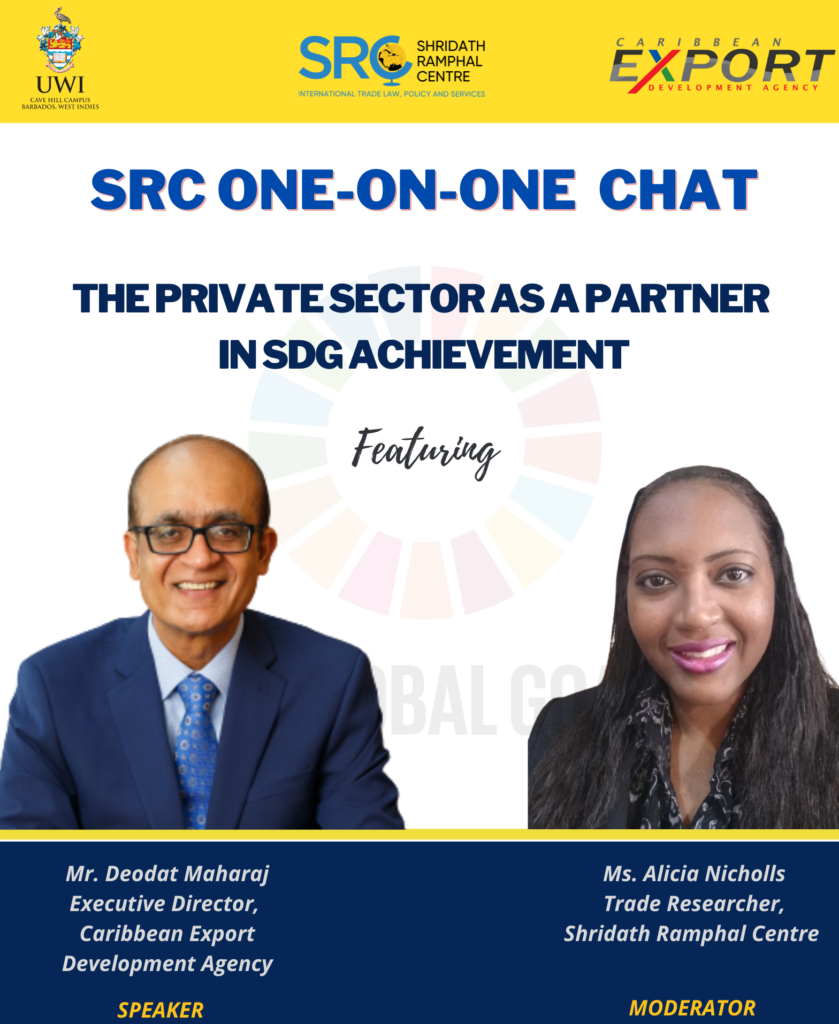
In this SRC One-on-One Chat, our SRC trade researcher Alicia Nicholls chats with Mr. Deodat Maharaj, Executive Director of Caribbean Export Development Agency on the topic “The Private Sector as a Partner in SDG Achievement”. Mr. Maharaj shares his vast insights on the role of the private sector in helping Caribbean SIDS meet the 17 United Nations Sustainable Development Goals (SDGs) and how Caribbean Export is helping in this endeavour. Watch the video recording below:
VIDEO LINK – Webinar 5: Caribbean-African Trade Webinar

Thank you to all who attended the final webinar in our Caribbean-Africa Trade Webinar series, Webinar 5, which took place on Thursday, 22 July. In case you missed it, please see the video recording below:
SRC holds Webinar on Private Sector Investment for SDG Achievement

On Thursday, August 5, the Shridath Ramphal Centre for International Trade Law, Policy & Services (SRC) of The University of the West Indies, Cave Hill (The UWI Cave Hill) held a webinar entitled “Facilitating Private Sector Investment for SDG Achievement in Caribbean SIDS“. It is the latest in a series of research and outreach outputs by the SRC examining the intersection between trade and the 17 United Nations (UN) Sustainable Development Goals (SDGs). The event, which was held virtually via Zoom teleconference, was attended by a wide cross-section of participants ranging from the local and international private sector, development agencies, academia and the general public. The SRC was pleased to have as the key note speaker Professor Jeffrey Sachs, Director of the Centre for Sustainable Development at Columbia University, who was introduced by SRC Director Dr. Jan Yves Remy. Professor Sachs’ key note remarks were followed by an hour-long panel discussion on the topic of the webinar. The distinguished panelists were Mr. Matthew Wilson (Chief, Special Projects of the International Trade Centre), Dr. Jason Haynes (Lecturer in Investment Law and Deputy Dean of Graduate Studies and Research at The UWI Cave Hill and Mr. James Ellsmoor (CEO, Island Innovation). The event was moderated by SRC junior research fellow, Alicia Nicholls. The recording from the event will be available shortly.
Webinar 5 – Caribbean-African Trade Webinar Series
Join the SRC on Thursday, July 22nd for the 5th and final in our co-hosted webinar series on Caribbean-Africa Trade! The featured speakers for this fifth webinar “Dispute Settlement Regimes” will be Mr. Claude Chase (Trade Lawyer) and Dr. Olabisi Akinkugbe (AfronomicsLaw). The event will be facilitated by Dr. Jan Yves Remy (SRC) and Khololefo Kugler (Trade Policy Exchange). See flyer above. Register for this and the upcoming webinars in the series here: https://zoom.us/webinar/register/WN_Hea1Q608Qk-YPukG5lHCqQ. Get the chance to watch the video recording for the fourth webinar here.
VIDEO LINK – Webinar 4: Caribbean-African Trade Webinar
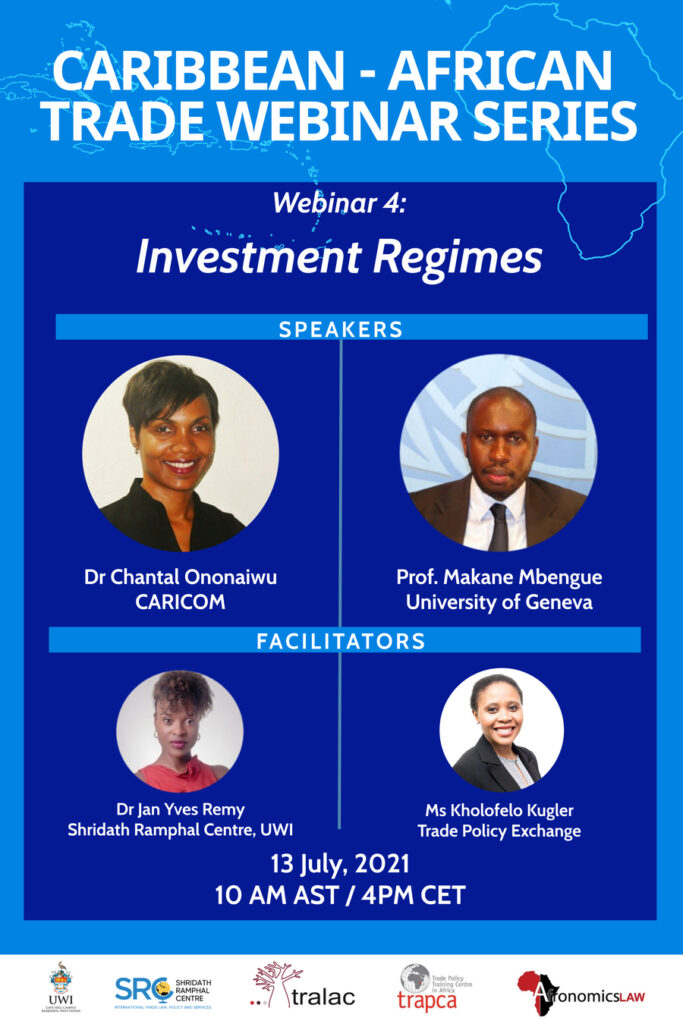
Thank you to all who attended Webinar 4 in our Caribbean-Africa Trade Webinar series, which took place on Tuesday, 13 July. In case you missed it, please see the video recording below: Remember that the registration link is the same for all the webinars! REGISTER HERE: https://zoom.us/webinar/register/WN_Hea1Q608Qk-YPukG5lHCqQ