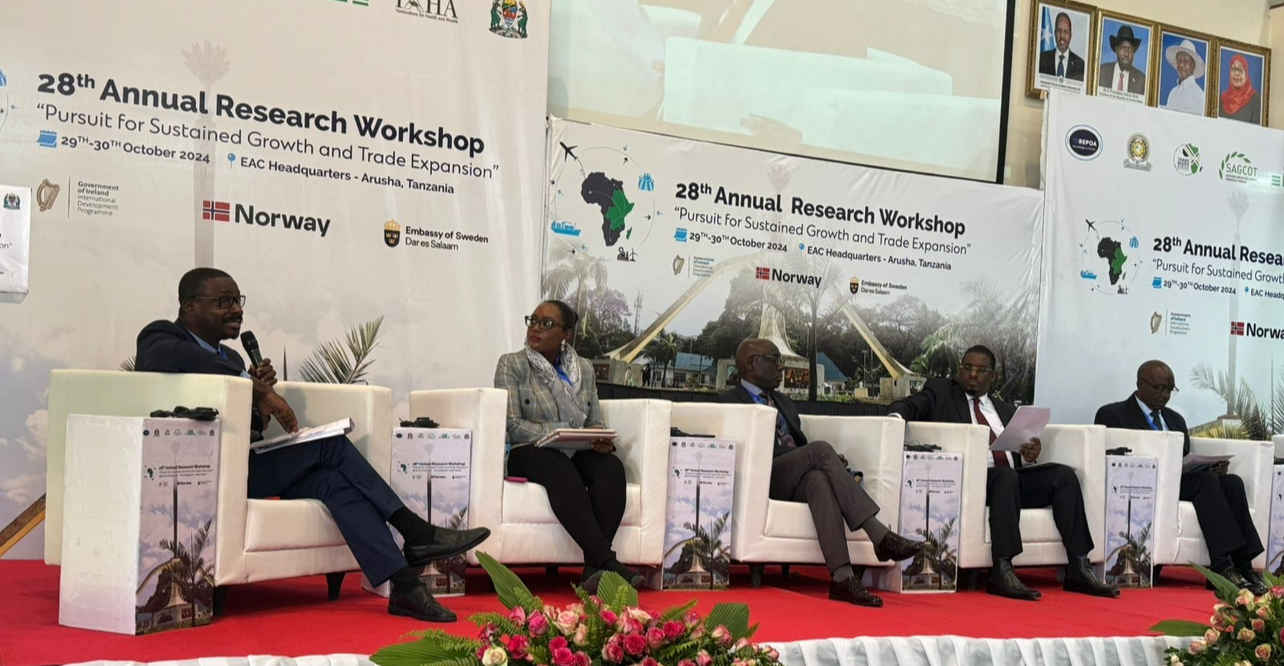
On October 29-30, 2024, I had the honour of representing the Shridath Ramphal Centre for International Trade Law, Policy and Services (SRC) of The University of the West Indies (The UWI) at REPOA’s 28th Annual Research Workshop in Arusha, Tanzania. With the imposing Mount Meru as its backdrop, this beautiful East African city played host to rich discussions and presentations under the theme “Pursuit for Sustained Growth and Trade Expansion”. It offered a unique platform to engage with fellow scholars, policymakers, businesspersons and civil society on topics of trade and development. While the focus was on the East African experience, there was much that resonated with me as a Caribbean person given our shared challenges. Indeed, participating in this workshop underscored to me the pressing need for deeper African-Caribbean academic research collaborations that could harness our shared knowledge and experience to develop innovative and evidence-based solutions to regional and global challenges. In this SRC Trading Thoughts, I reflect on this experience and propose some ideas for deeper Africa-Caribbean research collaboration and the role that the SRC can play in this regard.
A leading Tanzanian think tank and NGO, REPOA has for the past three decades been at the forefront of policy-oriented research aimed at fostering inclusive development in East Africa. REPOA hosts these workshops annually and this year’s theme centered around fostering sustained growth and trade expansion, two themes which hold significant relevance for the Caribbean as well. As the organisers were keen to hear the experience of the Caribbean region in expanding its exports, I therefore represented the SRC as a panelist on the first plenary session entitled “Opportunities and Challenges for Sustaining Trade Expansion” chaired by Hon Omar Said Shaaban, Minister of Trade and Industry, Tanzania. My co-panelists were Mr. Elias Kilembe (Energy Consultant with ECARDS) and Denis Karera (Gold Capital Investment).
These discussions made it pellucidly clear that despite geographical distance, Africa and the Caribbean face many similar challenges, including dependency on a narrow set of exports, vulnerability to global economic and geopolitical shifts, limited intra-regional trade, and the adverse impacts of climate change. Additionally, both regions are navigating complex regional integration processes, while also seeking to diversify their exports and export partners.
Since 2019, there has been deeper African-Caribbean collaboration at the political level, with the hosting of the now annual Africa-Caribbean Trade and Investment Forum (ACTIF), and other initiatives to foster closer African-Caribbean trade and economic links, such as establishing embassies, signing visa waiver agreements and air services agreements, hosting trade missions, inter alia. In reflecting on the REPOA conference, it became evident to me that deepening collaborative research could also be transformative for both regions, enabling us to enhance empirical knowledge, share experiences and develop empirically sound solutions to assist our policy makers and business people as they seek to deepen ties between our regions.
The SRC, as the region’s leading trade policy research, training and outreach institution is in a prime position to make this happen. Indeed, the SRC has played our part in this regard by seeking to build links with similar-minded African institutions, hosting a webinar series on African-Caribbean trade and also through several of our policy briefs. However, there is scope for even more work and greater collaborations. Below I outline some examples.
One such area is food security, a longstanding bugbear for the region. CARICOM is currently pursuing its 25 by 2025 initiative in which it seeks to reduce its food import bill by 25% by 2025. The region’s high food import bill, driven by a plethora of factors, is exacerbated by the intensity of hurricanes provoked by climate change. The devastation of Grenada’s nutmeg industry by Hurricane Ivan in 2004 and Barbados’ fisheries industry by Beryl in 2024 some twenty years later, are just two examples. There are many more. I was pleased to learn from the rich interventions from Mr. Geoffrey Kirenga and his team from Southern Agriculture Growth Centre of Tanzania (SAGCOT) that Tanzania not only was self-sufficient in food production but also the great work they were doing on the potato value chain. Collaborations between SAGCOT and Caribbean agricultural entities like CARDI would be useful to see what we could learn from them as we seek to build our food security. This is particularly germane for Barbados given recent media reports of poultry and fruit shortages, resulting in hardships for businesses which rely on these products and also for end consumers.
Both CARICOM and African countries are engaged in complex regional integration efforts. In Africa this is even more complicated as they are seeking to deepen integration within their Regional Economic Communities (RECs) while also implementing their continent-wide African Continental Free Trade Agreement (AfCFTA). However, both the Caribbean and Africa face challenges in achieving deeper levels of integration due to a myriad of economic, socio-cultural, political, and other factors. During the REPOA discussions, many familiar buzzwords and phrases like lack of political will, implementation deficit and lack of trust constantly arose, not dissimilar to in the Caribbean. However, it is clear that there are areas in which the two regions could learn from each other. For instance, African countries have made progress with their Pan-African Payments Settlement System (PAPPS), a project of the African EXIM Bank and which Caribbean countries could benefit from. Indeed, Africa has been a leader in the area of fintech and using these technologies to promote financial inclusion.
Cooperation initiatives already exist. For example, The UWI has MOUs with some African universities. Moreover, in 2023 several UWI academics, including myself, became founding members of ALADAA Caribe, the Caribbean branch of the Latin American Association for Asian and African Studies (ALADAA by its Spanish initials). ALADAA, which was created in 1976, has done tremendous work over the years in fostering exchange, collaboration and research among academics in Latin America, Asia and Africa. The newly formed Caribbean chapter aims to provide a Caribbean voice to this important work. Another initiative in which I am also involved in a personal capacity is the Pan-African Leadership Institute (PALI), serving as that organisation’s global ambassador for Barbados since earlier this year. Founded in 2020, this institute provides executive leadership training and education for leaders across the African diaspora and has alumni stretching across the globe, including more recently in the Caribbean.
These initiatives are all laudable but I suggest that there is a need for a bespoke Africa-Caribbean Trade Research Network, an initiative that could institutionalize trade and development research collaboration between our regions by providing a structure for sustained engagement on trade and development issues among universities and institutions like the SRC, think tanks like REPOA and other like-minded institutions in Africa and the Caribbean. Such a network could serve as a knowledge-sharing hub, hosting annual conferences, joint research projects, and policy dialogues and research fora. Technology makes such collaboration much easier than previously. Through this network, researchers could conduct empirical research on mutual development challenges, promote knowledge exchange, and foster a sense of solidarity between Africa and the Caribbean going beyond just bilateral institutional partnerships.
I am thankful for the chance to have represented SRC at this event and to the REPOA team ably led by Dr Mmari for engaging us. My experience at REPOA’s 28th Annual Research Workshop reinforced the importance of collaboration between Africa and the Caribbean in addressing shared challenges and seizing emerging opportunities. By working together, Africa and the Caribbean can create a research ecosystem that supports sustainable development, advances regional integration, and promotes social and economic resilience. Research can serve as a powerful tool for change, allowing our policy makers and businesspersons to have the empirical data on which to make sound decisions, ultimately redounding to our collective benefit.
Alicia D. Nicholls, B.Sc., M.Sc., LL.B. is the SRC’s Junior Research Fellow. Learn more about the SRC at www.shridathramphalcentre.com.