


Is the WTO still relevant in its current configuration? – A perspective from the Caribbean
Neil C.A. Paul$*Over the last few years, the issue of the relevance of the World Trade Organization (WTO) has been raised in many quarters of its membership. The WTO, is a system of multilateral trade Rules which governs global trade for more than 160 countries. It is a part of the Bretton Woods institutions, including the International Monetary Fund (IMF) and World Bank (WB). In a sense the WTO is a legacy of the original Bretton woods agreement which included ideas for an international Trade Organization (ITO), and according to a publication, Bretton Woods Project (2005), “these lay dormant until the WTO was created in 1995. Like the other organizations in this system, the WTO has been under pressure for some time as nations negotiate to improve their economies through trade liberalization. There is a sense that the reality in the exercise of these agreements is somewhat different and perhaps…
Can CARICOM Afford to Miss the WTO E-Commerce Train?
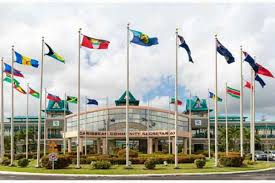
Can CARICOM Afford to Miss the WTO E-Commerce Train? Author: On the sidelines of this year’s World Economic Forum meeting in January at Davos, Switzerland, 76 Members of the World Trade Organization (WTO) expressed their intention to begin WTO negotiations on electronic commerce (e-commerce). Making up less than half of the WTO’s overall membership, these willing Members entreated other Members to join them in negotiating rules aimed at facilitating the use of e-commerce in trade. All independent CARICOM Member States, with the exception of the Bahamas – which is presently acceding to the WTO – are WTO Members and therefore eligible to join these negotiations. However, so far none has SRC Trading Thoughts May 22, 2019 On the sidelines of this year’s World Economic Forum meeting in January at Davos, Switzerland, 76 Members of the World Trade Organization (WTO) expressed their intention to begin WTO negotiations on electronic commerce (e-commerce). Making up less than half of the WTO’s overall membership, these willing Members entreated other Members to join them in negotiating rules aimed at facilitating the use of e-commerce in trade. All independent CARICOM Member States, with the exception of the Bahamas – which is presently acceding to the WTO – are WTO Members and therefore eligible to join these negotiations. However, so far none has done so. Given the potential of e-commerce for their development, should CARICOM Member States reconsider their cautionary stance? Growing importance of e-commerce to global trade E-commerce, also referred to as “digital trade”, has been defined as “the production, distribution, marketing, sale and delivery of goods and services through electronic and digital means”. In its World Trade Report 2018, the WTO noted that digital technologies – such as artificial intelligence, blockchain, the Internet of Things and 3-D printing – are reducing trade costs and revolutionizing the structure and patterns of global trade flows. The United Nations Conference on Trade and Development (UNCTAD) estimated the global e-commerce market to be around US $22.1 trillion in 2015. The WTO Report and numerous studies highlight the potential of e-commerce to catalyse economic transformation in developing countries by lowering trade costs, increasing market access opportunities for Micro, Small and Medium-Sized Enterprises and individual entrepreneurs, improving logistics, and widening consumer choice. Challenges, however, continue to plague the use of these technologies, including inadequate supportive policies, technology diffusion and regulation. While more modern regional trade agreements – like the US-Mexico-Canada Agreement and even the CARIFORUM-EU Economic Partnership Agreement – include comprehensive digital trade chapters, the WTO, which was negotiated in 1995, still does not contain a multilateral agreement dealing holistically with e-commerce. Instead, separate disciplines affecting digital trade in goods and services can be found in the WTO’s General Agreement on Trade in Services, the General Agreement on Tariffs and Trade, the Agreement on Trade-Related Aspects of Intellectual Property Rights, and more recently, the Trade Facilitation Agreement. The multilateral route: The WTO Declaration and Work Programme on E-Commerce Multilateral discussions on e-commerce involving all WTO Members were launched in 1998 through the adoption of a Declaration on Global Electronic Commerce, and a Work Programme to examine trade-related issues related to global electronic commerce. The Work Programme has been continuously updated at most WTO Ministerial Conferences since 1998, the last one being the Buenos Aires Ministerial Conference in 2017. Under that Work Programme, the WTO’s main committees have been reviewing progress on discussions, with general oversight provided by the WTO’s General Council. Despite fits of activity, and some proposals by select countries, not much has yet been accomplished beyond a temporary moratorium on the application of customs duties on electronic transmissions and the formulation of a working definition of e-commerce. Although the negotiation of a multilateral agreement or rules among all 164 WTO Members would be ideal, consensus among all Members has been difficult to achieve. This is in large part due to developing countries’ objections to what they consider to be ambitious proposals being pushed by developed countries. On the one hand, WTO developing countries, led by India and the African Group of countries, support completion of the more limited mandate under the 1998 Work Programme framework. On the other hand, developed countries, such as the US and the European Union, advocate moving beyond mere discussions to actual negotiations to formulate rules aimed at increasing e-commerce opportunities in the twenty-first century. Where CARICOM stands is unclear as no CARICOM government has to date tabled a proposal on e-commerce at the WTO. The plurilateral route: Joint Statements on Electronic Commerce at Buenos Aires and at Davos Without an official WTO mandate to proceed with multilateral negotiations, some WTO Members have begun negotiations on a plurilateral basis, that is, without all WTO Members but among a subset of willing ones. The plurilateral discussions began when 71 Members signed a Joint Statement on E-Commerce in Buenos Aires in 2017, and was extended at Davos in January this year, when five more countries, including China, agreed to join the plurilaterals. In their Joint Statement at Davos, the 76 signatories agreed, inter alia, to achieve “a high standard outcome that builds on existing WTO agreements and frameworks with the participation of as many WTO members as possible”. The willing countries also agreed to “recognize and [to] take into account the unique opportunities and challenges faced by members, including developing countries and Least Developed Countries (LDCs), as well as by micro, small and medium sized enterprises, in relation to electronic commerce”. Should CARICOM countries participate in plurilateral negotiations? As with the multilateral e-commerce negotiations, CARICOM countries’ have remained silent on whether they have an appetite for joining the plurilateral e-commerce negotiations. A number of factors could account for their apparent hesitation. Firstly, CARICOM countries may be concerned about their capacity to engage in negotiations on an area of trade which is still relatively new and evolving, and their subsequent ability to implement in a timely manner any obligations undertaken. To allay such fears, it might be worth considering the approach to special and differential treatment
4th SRC Lunch Time Chat: Chat title: Influencing the Special and Differential Treatment Discussion at the WTO: What role for Small States?
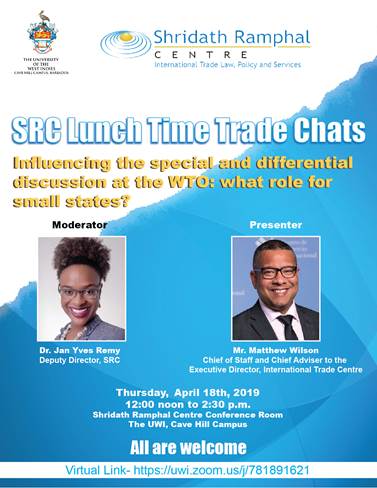
Thursday, April 18th, 2019 at 12:00-2:30 pm Presenter: Mr. Matthew Wilson (ITC) Moderator: Dr. Jan Yves Remy
Ieye News: Caribbean has stake in UNCITRAL Investor-State Dispute Settlement Reform
(PRESS RELEASE) – Caribbean States must make their voices heard in the Investor-State Dispute Settlement (ISDS) reform discussions currently underway in the United Nations Commission on International Trade Law (UNCITRAL). This was the strong take-away message from the 5th SRC Lunch Time Chat held by the Shridath Ramphal Centre for International Trade Law, Policy & Services (SRC) of the University of the West Indies (UWI), Cave Hill Campus on Tuesday, May 14, 2019 at the SRC’s Conference Room, CARICOM Research Building, the UWI.
3rd SRC Lunch Time Chat: The ECCB Digital Currency Pilot
Date: Tuesday, March 19, 2019 at 12:30-2:00 pm (Barbados time, GMT -4). Panelists: Ms. Sade Jemmott, General Counsel – BITT Inc. and Marla Dukharan, Chief Economist – BITT Inc. Moderator: Dr. Jan Yves Remy, Deputy Director, SRC
2nd SRC Lunch Time Chat: Inclusionary Governance Reform
Date: Wednesday, March 6th, 2019 (Barbados time, GMT -4). Panelists: Dr. Kai-Ann Skeete, Trade Research Fellow, SRC and Dr. Wayne Charles-Soverall, Senior Lecturer, Faculty of Social Sciences, The University of the West Indies, Cave Hill Moderator: Dr. Kai-Ann Skeete