


IDB Invest Paid Internships
Dear Interns, Yesterday, we launched the external competition for 2021 Remote Summer Internship Program for HQ. This Friday, March 5th, from 1-2 PM Washington, D.C. time, we are hosting a zoom informative session focus on attracting candidates from The Caribbean region. The event is organized in collaboration with a group from IDB Invest, but we welcome all participants interested to learn about our internship opportunities. We will talk about working at IDB Invest, the internship program, and answer any questions that the audience have about the application. Topic: Webinar: IDB Invest Paid Internships Time: Mar 5, 2021, 1:00 PM Eastern Time Join Zoom Meeting: Join our Cloud HD Video Meeting Zoom is the leader in modern enterprise video communications, with an easy, reliable cloud platform for video and audio conferencing, chat, and webinars across mobile, desktop, and room systems. Zoom Rooms is the original software-based conference room solution used around the world in board, conference, huddle, and training rooms, as well as executive offices and classrooms. Founded in 2011, Zoom helps businesses and organizations bring their teams together in a frictionless environment to get more done. Zoom is a publicly traded company headquartered in San Jose, CA. zoom.us Meeting ID: 960 9839 7827 Passcode: 723311
SRC LTC – Strengthening CARICOM-US Trade & Investment Relations – VIDEO RECORDING
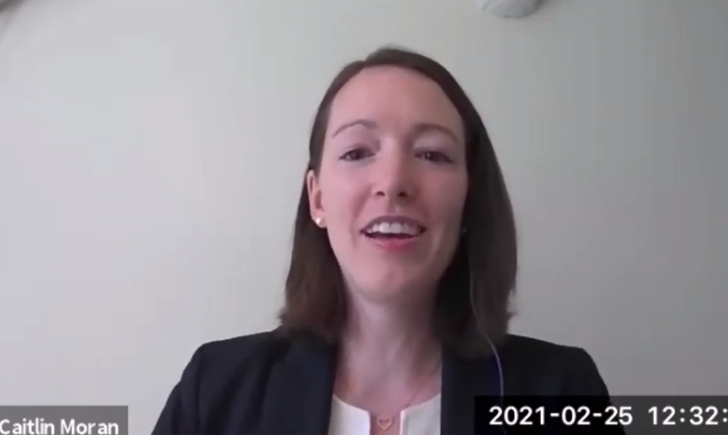
For all those who missed or just want a review of our latest SRC Lunchtime Chat “Strengthening CARICOM-US Relations Through Trade and Investment”, we have great news for you. Get the chance to watch the video by just clicking the link below.
SRC Director to speak at Panel Discussion on Globalisation of Education – March 4, 2021
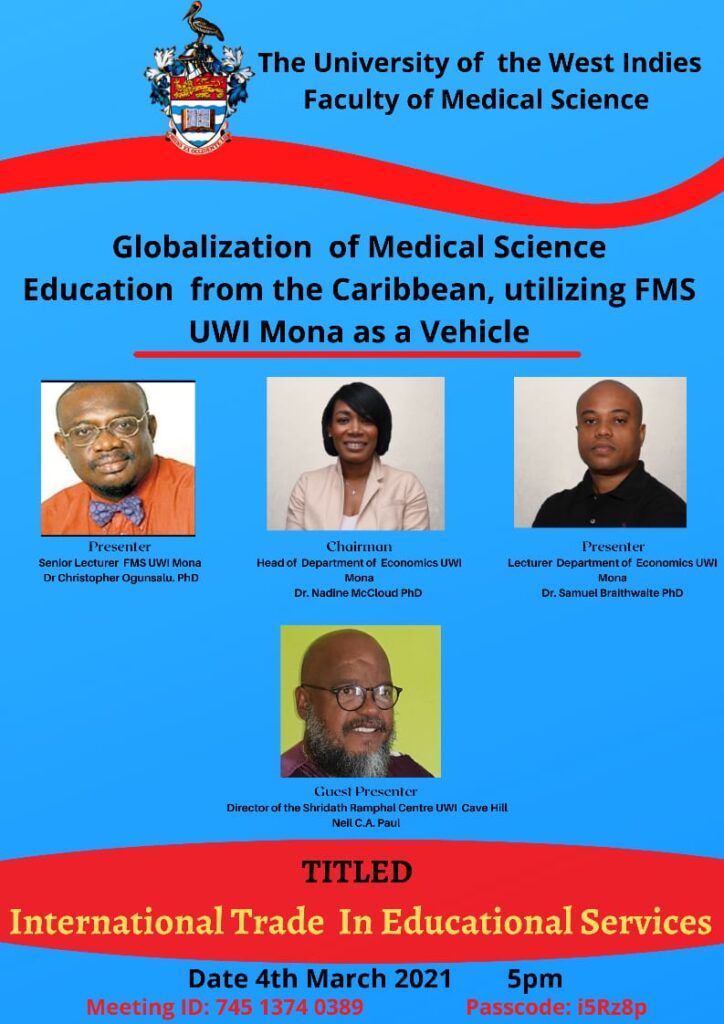
On Thursday, March 4 at 5 pm (Jamaica time) (6 pm Barbados time), SRC Director Neil Paul will be among the distinguished panel of presenters at The University of the West Indies Cave Hill’s Faculty of Medical Science’s panel discussion on “Globalisation of Medical Science Education from the Caribbean, utilising FMS UWI Mona as a vehicle”. Mr. Paul will speak on the issue of international trade in educational services. See the flyer below for further event details.
Never let a good crisis go to waste: Revisiting the CARICOM Single Domestic Space
Dr. Kai-Ann Skeete$*Former British Prime Minister Sir Winston Churchill who led Britain through World War II is credited as saying “never let a good crisis go to waste.” It is with these words that I pen this article to advance my opinion on the way forward for the regional integration movement in light of the upcoming virtual 32nd Inter-Sessional Meeting of the Conference of Heads of CARICOM Government…
WHAT IS AT STAKE FOR DEVELOPING COUNTRIES IN TRADE NEGOTIATIONS ON E-COMMERCE?
What is at stake for developing countries in trade negotiations on e-commerce? The case of the joint statement initiative – unctad.org
SRC LTC – Strengthening Caribbean-US Trade & Investment Relations – Feb 25, 2021
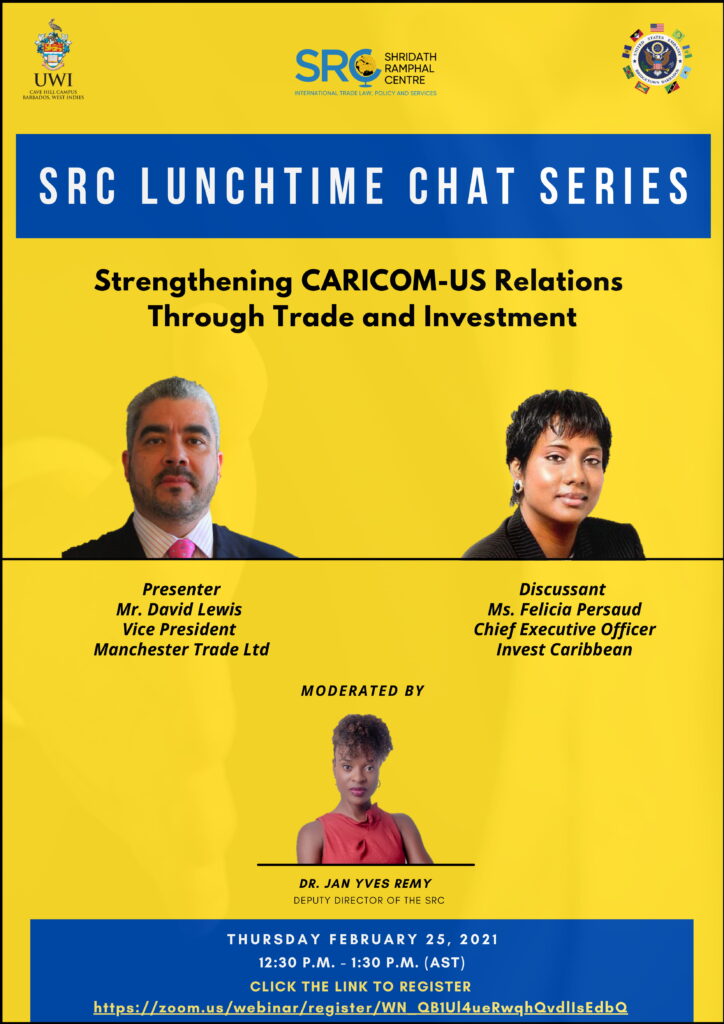
The SRC is pleased to invite you to our upcoming virtual SRC Lunch Time Chat entitled “Strengthening CARICOM-US Relations through Trade and Investment”. As the dust settles on the new Biden-Harris Administration, questions loom as to what a trade and investment agenda for CARICOM and the US will look like going forward. Join us for a discussion with Dr. David Lewis and Felicia Persaud about the challenges and opportunities they see for advancing and revitalizing government and business relations between our region and the US.” The session will be moderated by SRC Deputy Director, Dr. Jan Yves Remy. The chat will take place via Zoom on Thursday, February 25, 2021 at 12:30-1:30 PM (AST). REGISTRATIONTo register, please click here: https://zoom.us/webinar/register/WN_QB1Ul4ueRwqhQvdlIsEdbQ Please see the flyer above for further details.
High-Level Regional Roundtable on the WTO Investment Facilitation for Development Negotiations: Caribbean Perspectives

We cordially invite you to attend our upcoming High-Level Regional Roundtable on the WTO Investment Facilitation for Development Negotiations: Perspectives from Caribbean Economies,jointlyorganized by the Shridath Ramphal Centre for International Trade Law, Policy & Services of The University of the West Indies, the International Trade Centre (ITC), the German Development Institute/Deutsches Institut für Entwicklungspolitik (DIE) and the World Economic Forum (WEF), in the framework of the Investment Facilitation for Development project, jointly implemented by ITC and DIE. The roundtable will take place on 24 February 2021, from 10:00 am to 12:30pm (Barbados, GMT -4) time and is meant to: offer a platform for strategic exchange on the WTO negotiations on investment facilitation for development among a selected group of high-level policy makers, government officials, private sector representatives and eminent academic scholars, focused on Caribbean economies. Objectives The roundtable will: Provide a brief background on the progress of the WTO negotiations on investment facilitation for development; Serve as a platform for an exchange of the views and the interests of Caribbean economies in these negotiations;. Focus on the value-added of a WTO Investment Facilitation Framework for Development for Caribbean economies, the main challenges and concerns that ought to be taken into consideration in these negotiations, especially as they relate to sustainable FDI and sustainable development; Facilitate awareness raising, joint learning and capacity building among participants; and. Generate a report which will distil key policy recommendations from the discussions at the roundtable. The Roundtable will be held under the Chatham House Rule to facilitate open and results-oriented discussions. Although the roundtable is focused on the WTO Investment Facilitation for Development negotiations from the Caribbean economies’ perspective, it will address issues that will be of interest to investment promotion agencies and policy makers outside the region. Please feel free to circulate within your networks. Speakers The programme including the list of the distinguished speakers and their bios may be accessed here. Registration Pre-registration will be mandatory for attendance. To register for the event and receive the meeting-link details, please register here. Please note that, to avoid any difficulties, only participants who register will receive the password to join the on-line roundtable.
SRC congratulates new WTO DG Ngozi Okonjo-Iweala

The SRC wishes to extend heartfelt congratulations to Dr. Ngozi Okonjo-Iweala on her appointment today February 15, 2021 as the seventh Director-General of the World Trade Organization. Dr. Okonjo-Iweala, who makes history by being the first female WTO DG and first from Africa, will assume office officially on Marh 1, 2021.
Vaccine Nationalism is a Zero-Sum Game
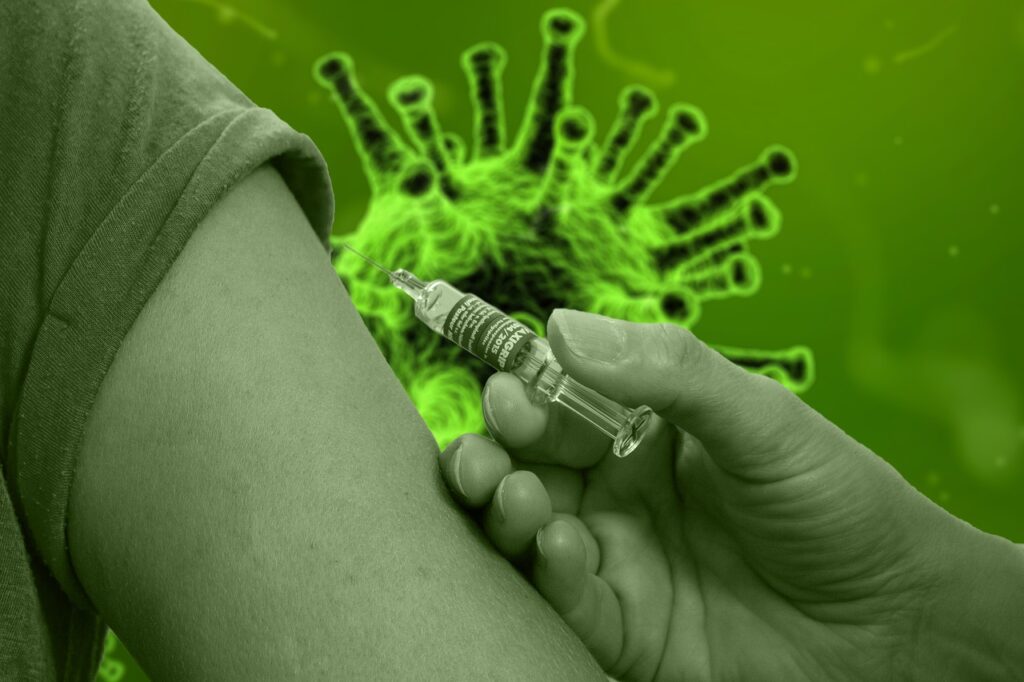
By: Joel K. Richards A year ago, developing a vaccine to combat the novel coronavirus (COVID-19) pandemic by the end of 2020 seemed like an impossible task. Afterall, based on previous experience, vaccines typically required up to 10 years or more to develop. However, as Nelson Mandela once said, “It always seems impossible until it is done.” In this vein, what once seemed impossible, has now been achieved and there are currently multiple vaccine candidates to inoculate against COVID-19, each with varying levels of efficacy. Traditionally, the world has had very good experiences with respect to the development and distribution of vaccines. According to Douglas Broom of the World Economic Forum (WEF), vaccination is one of the world’s most successful health interventions, saving as many as 3 million lives every year. To understand the importance of vaccines, one only has to wonder how many persons would have died or been unable to lead healthy and productive lives had there been no immunisation for Polio, Tuberculosis, Measles/Rubella, Yellow Fever and many other diseases. Plain and simple, vaccines save lives and those developed and being developed for COVID-19 are no different. However, as Henrietta Fore, Executive Director, United Nations Children’s Fund (UNICEF), mentioned on 3 February in an article penned for the Davos Agenda of the WEF, “vaccine nationalism” threatens to undermine equitable distribution of COVID-19 vaccines. Through the COVID-19 Vaccines Global Access (COVAX) facility, 186 countries have joined forces to ensure the fair allocation of COVID-19 vaccines to all countries, including the poorest countries. COVAX is aiming aim to deliver more than 330 million vaccine doses in the first half of 2021. Notwithstanding the highly commendable efforts under the COVAX facility, according to the British Broadcasting Corporation (BBC), research shows that most vaccine doses have been purchased by high-income countries. Research by the Duke Global Health Innovation Center suggests that high-income countries currently hold a confirmed 4.2 billion doses (potential vaccines), while low-middle income nations hold 670 million. One wealthy and highly advanced country has even pre-ordered nearly 9 doses of vaccines for each of its citizens. To further highlight the concerns about vaccine inequality, the head of the World Health Organization (WHO), Tedros Adhanom Ghebreyesus, has said that more than 39 million doses have been administered in at least 49 higher-income countries, but only 25 in one of the lowest-income countries. A race to the bottom to secure vaccines is in no one’s best interest. The pandemic will not end simply by defeating COVID-19 in rich countries alone. The pandemic will end when there is a coordinated and concerted global effort to distribute vaccines and other treatments equitably, until the vast majority of the global population is protected against the virus. Ultimately, in a zero-sum game of vaccine nationalism, no one comes out better off. One can only hope that fears about vaccine nationalism are overblown. Afterall, some small developing countries are expecting their first doses of vaccinations very soon. For instance, officials in Barbados recently announced that the country is in line to receive 100,000 doses of the Oxford-AstraZeneca vaccine, enough to inoculate about one-third of its population. This notwithstanding, international pressure must be maintained to allow for all countries to have a fair shot at vaccinating their people against COVID-19. Finally, beyond the issue of vaccine inequality, the other fundamental matter of public trust in vaccines also needs to be addressed. Citizens have a legitimate right to feel safe taking any vaccine and vaccine manufacturers, governments and relevant international bodies also owe it to the public to be transparent and accountable. We can get over the vaccine nationalism hurdle, but the greater hurdle might yet be public distrust in vaccines, and this is a difficulty that must be overcome to improve our chances of beating COVID-19 sooner rather than later. Joel K. Richards is a Vincentian national living and working in Europe in the field of international trade and development.
The Energy Transition

Stefan Newton$*Economic and human activity depends on the use of energy. The Industrial Revolution was made possible by harnessing the power of fossil fuels to service manufacturing, transport, and large urban settlements. While fossil fuel energy has positively changed human life, burning fossil fuels emits carbon dioxide (CO2), a greenhouse gas, which has caused global warming resulting in climate change. It is scientifically recognized that changing the energy mix from…