


Beyond Sun, Sand and Sea: Developing an Inclusive, Sustainable & Resilient Tourism Sector in Barbados

Chelcee Brathwaite$*Barbados’ tropical temperatures, year-round sunshine and award-winning beaches undeniably create a natural comparative advantage luring millions of tourists. Recording its third consecutive year of growth in stayover arrivals, Barbados welcomed 680,269 stayover visitors and 614,933 cruise passengers in 2018, according to the BTMI’s latest annual report.[1] Tourism, Barbados’ biggest foreign exchange earner…
Five Priority Areas for a Caribbean International Trade Agenda in 2021
Dr. Jan Yves Remy$*January is the time for making New Year’s resolutions and as the month draws to a close (already!), I want to squeeze in my wish list for the region’s top five trade negotiating priorities for the year 2021.
As my colleague, Alicia Nicholls explains in her piece this month, 2020 was a torrid year for international…
NEW DATE! SRC LTC – How the CSN Can Use Blockchain to Promote Trade – Feb 3, 2021
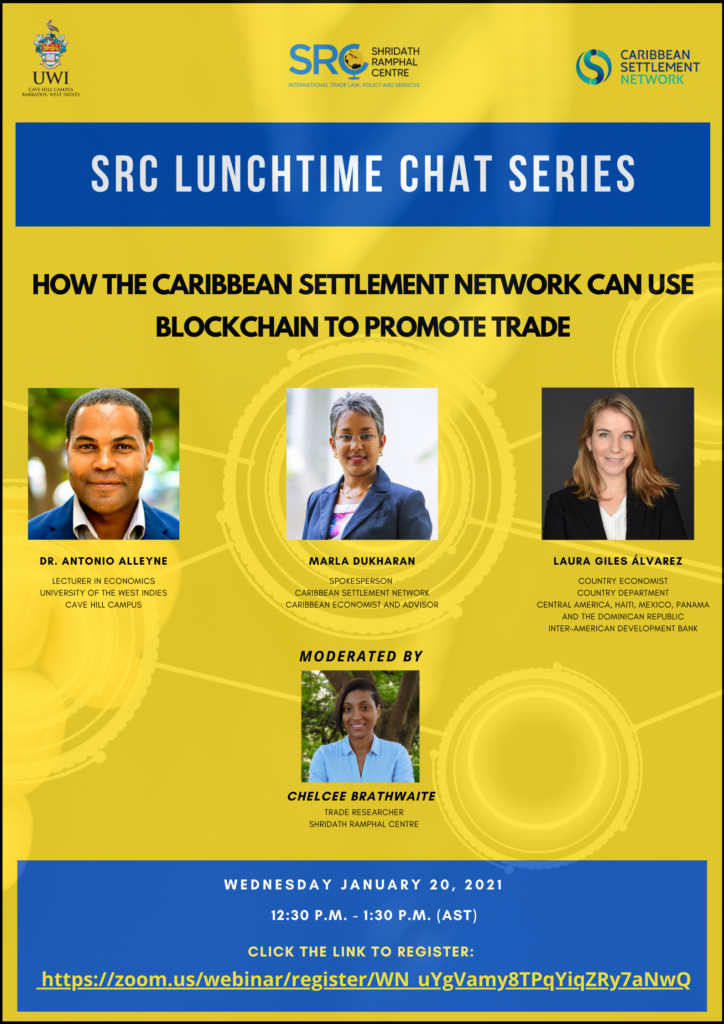
In a recent IDB publication, entitled, “A Caribbean Settlement Network: Can Blockchain Ease Intraregional Trade in the Caribbean?”, the authors explore the potential that a blockchain network in the Caribbean holds for reducing non-tariff trade costs and consequently, promoting trade. Across CARICOM, intraregional trade is declining, while trade costs, specifically non-tariff ones, are rising. With increasing empirical evidence suggesting that distributed ledger technologies can reduce non-tariff barriers, the authors highlight how the use of blockchain technology in trade can produce positive results and increase the region’s trade competitiveness. Against this backdrop, the SRC invites you to its upcoming Lunchtime Chat entitled: “How the Caribbean Settlement Network Can Use Blockchain To Promote Trade”. Join us virtually on Wednesday, February 3, 2021 at 12:30 p.m. (AST) to hear directly from the authors of this IDB publication! Register today using the new registration link here: https://zoom.us/webinar/register/WN_bU9q0tVBTyCBxxwygtWJpA
H.E Ambassador Chad Blackman – UNCTAD XV Host-Country Led Informal Dialogue on UNCTAD
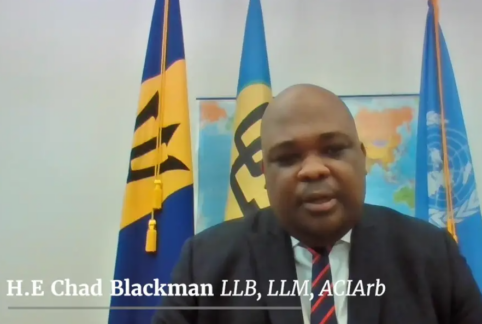
H.E. Chad Blackman, Barbados’ Ambassador and Permanent Representative to the United Nations and Other International Organizations at Geneva, shares the concept with members on the upcoming Host Country (UNCTAD XV) Led Informal Dialogue with Member States on UNCTAD and the way forward, in addressing the many challenges and opportunities for developing countries.
SRC/Anchor Group Webinar – January 27, 2021
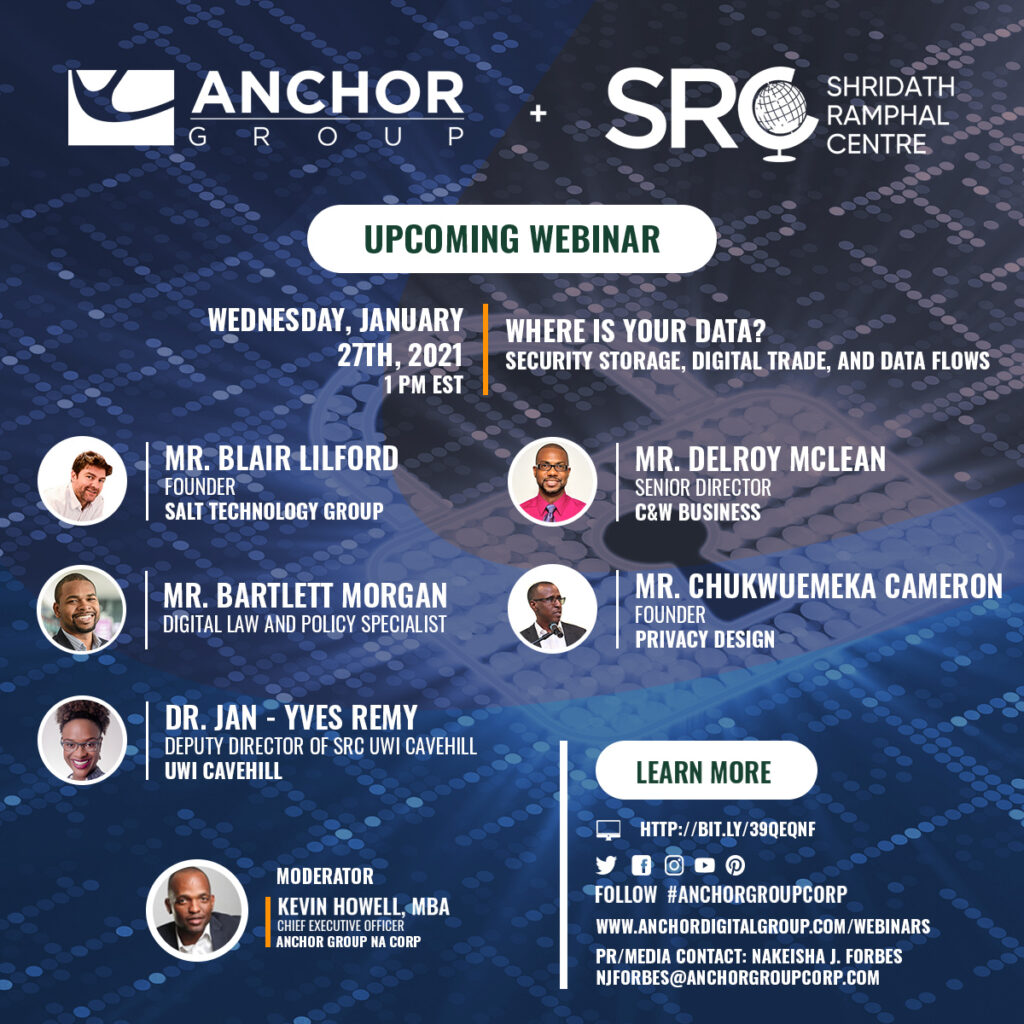
As we navigate the current digital landscape, organizations are increasingly looking towards solutions to their data, cloud solutions and revolutionary technology to cut the cost of development and maintenance and still achieve highly reliable and elastic services. Our esteemed group of panelists will offer insights and a panoramic perspective: Mr. Kevin Howell – Chief Executive Officer, Anchor Group NA (Moderator)Mr. Blair Lilford- Founder, SALT Technology GroupMr. Delroy McLean – Senior Director, B2B, C&W BusinessMr. Bartlett Morgan – Digital Law and Policy SpecialistMr. Chukwuemeka Cameron – Founder, Design PrivacyDr. Jan – Yves Remy – Deputy Director of SRC UWI Cavehill, UWI Cavehill REGISTER NOW: https://lnkd.in/gKUancz
Postponement of SRC Lunch Time Chat “How the Caribbean Settlement Network can use blockchain to promote trade”

Dear Friend of the SRC, We regret to inform you that our SRC Lunch Time Chat “How the Caribbean Settlement Network can use Blockchain to Promote Trade” scheduled for today Wednesday, January 20, 2021, has been postponed due to technical issues beyond our control. We sincerely apologise for this. The new date and time and a fresh registration link will be communicated to you in subsequent correspondence. We apologise for any inconvenience and thank you for your continued support of the SRC’s work. We look forward to you joining us for the rescheduled event. Kind regards, The SRC Team
Could 2021 be a comeback year for global trade?
Alicia Nicholls$*2020 was one of the most disruptive years in recent memory for global trade and the rules-based multilateral trading system. The COVID-19 pandemic triggered a sharp contraction in global merchandise trade growth which was already slowing due to escalating trade tensions among major trading powers. It disrupted global supply chains, provoking calls for nearshoring. The International Civil Aviation…
VIDEO – SRC One on One Chat with Dr. Mustaqeem De Gama on WTO COVID-19 TRIPS Waiver Proposal
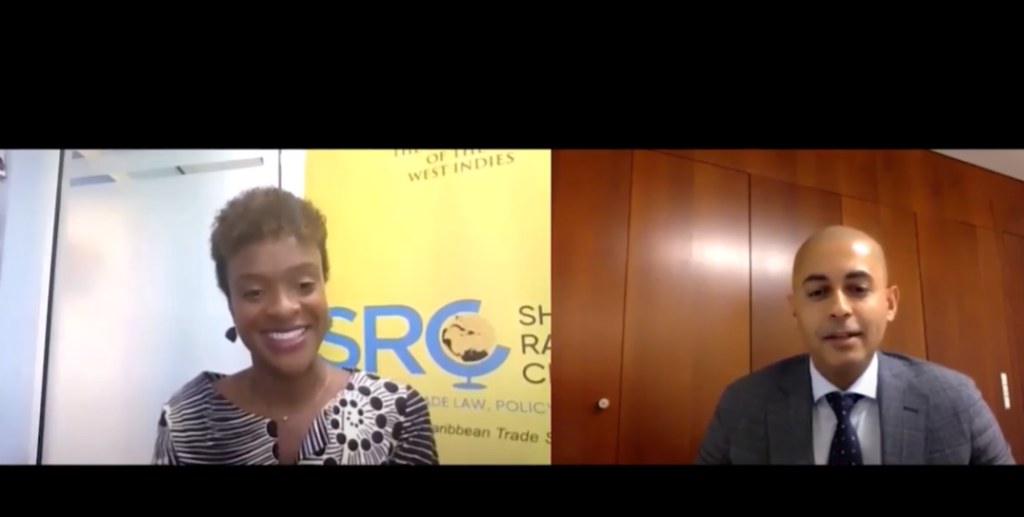
The SRC is pleased to share our SRC 1 on 1 Interview with Dr. Mustaqeem De Gama, South African Representative to the World Trade Organization (WTO), and co-proponent of the WTO Waiver for a Covid-19 Vaccine and other treatments. In this interview, hosted by the SRC’s Deputy Director Dr Jan Yves Remy, Dr. De Gama explains the rationale for his proposed waiver from WTO TRIPS obligations and tells us why CARICOM Countries should support it. Watch the video here: The interview follows from an SRC Trading Thoughts article entitled “Should CARICOM countries support a TRIPS waiver to access the COVID-19 vaccine?” which was co-authored by Dr. Remy and Dr. De Gama and available here.
Should CARICOM Countries support a WTO TRIPS Waiver to access the COVID-19 Vaccine?

Jan Yves Remy and Mustaqeem De Gama$*Through its Resolution WHA73.1 of 19 May 2020, the World Health Organization recognizes that the COVID-19 pandemic has a disproportionately heavy impact on the poor and the most vulnerable, with repercussions on health and development gains, in particular, in low-income countries…
A WTO Trade Response for CARICOM to Counter EU blacklisting?

Dr. Jan Yves Remy and Alicia Nicholls$*Two Caribbean Community (CARICOM) countries, Barbados and Trinidad and Tobago, are among the twelve predominantly small states and dependencies included on the EU’s updated “blacklist” of October 6, 2020. The arbitrary inclusion of some CARICOM Member States (MS) on large countries’ national tax “blacklists” remains a vexing issue…