


UPDATED: SRC hosts Webinar on COVID-19: On the Frontline at the WTO
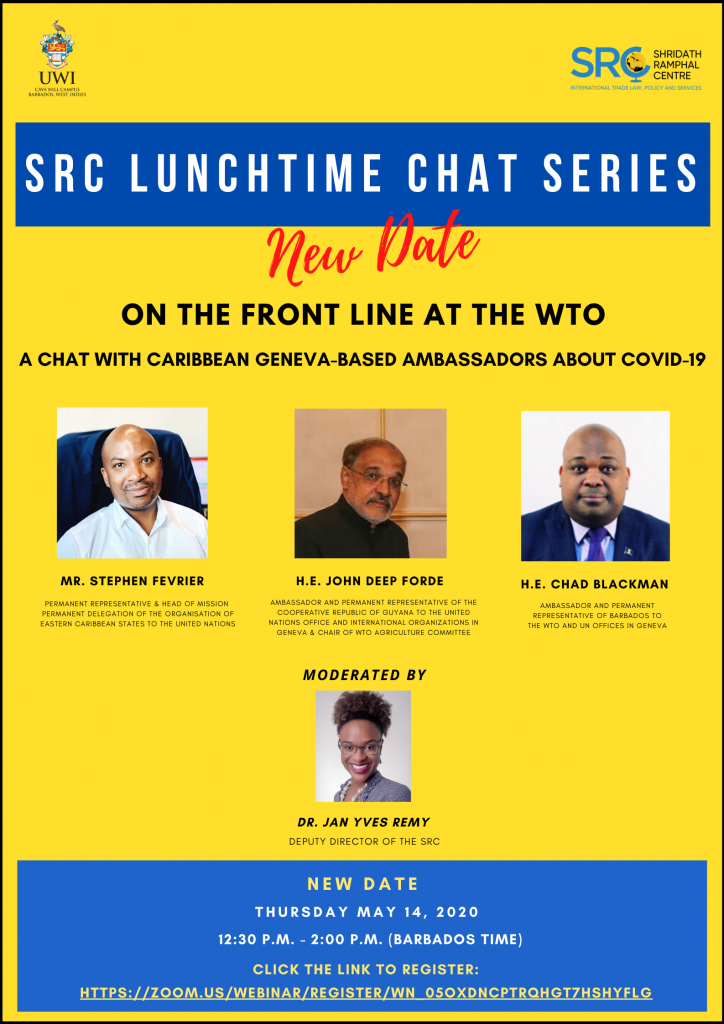
The SRC held its rescheduled Webinar on ‘COVID-19: On the Frontline at the WTO’ with CARICOM’s Geneva-based Ambassadors on Thursday, May 14, 2020 at 12:30-2:00 (Barbados Time). The distinguished panelists were: Ambassador H.E. John Deep Ford (Ambassador and Permanent Representative Of The Cooperative Republic Of Guyana To The United Nations Office And International Organizations In Geneva & Chair Of WTO Agriculture Committee) Ambassador H.E. Chad Blackman (Ambassador and Permanent Representative Of Barbados To The WTO and UN Offices In Geneva) Mr. Stephen Fevrier (Permanent Representative & Head Of Mission Permanent Delegation Of The Organisation Of Eastern Caribbean States To The United Nations). The event was ably moderated by SRC Deputy Director Dr. Jan Yves Remy and was well-attended by persons from the academic, business and wider trade community. The SRC sincerely thanks our esteemed panel of Ambassadors for sharing their insights and for all who attended this informative session. The recording may be accessed here:
WTO goods barometer flashes red as COVID-19 disrupts world trade
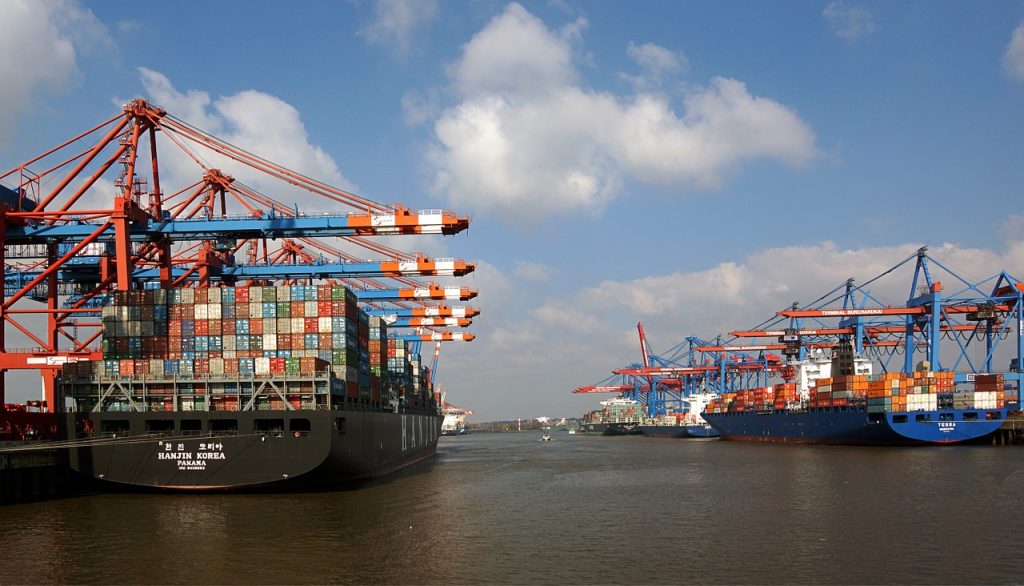
The World Trade Organization (WTO) has warned that COVID-19 is disrupting world trade based on results from its latest ‘Goods Trade Barometer’. In a press release of May 20, multilateral organization responsible for world trade noted: “The volume of world merchandise trade is likely to fall precipitously in the first half of 2020 as the COVID-19 pandemic disrupts the global economy, according to the WTO Goods Trade Barometer released on 20 May. The index currently stands at 87.6, far below the baseline value of 100, suggesting a sharp contraction in world trade extending into the second quarter. This is the lowest value on record since the indicator was launched in July 2016.” Read the full WTO article here.
CCJ Academy Webinar: Legal Dimensions Arising from COVID-19 Pandemic
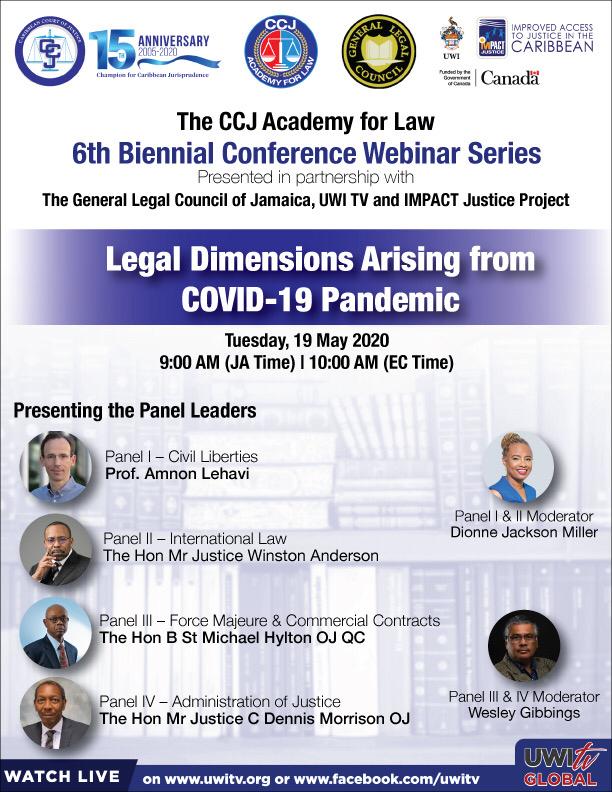
The Caribbean Court of Justice (CCJ) Academy will be hosting a Webinar entitled “Legal Dimensions Arising from the COVID-19 Pandemic” on Tuesday, 19 May 2020. Please see flyer for details.
Initiative on Model Provisions for Trade in Times of Crisis and Pandemic in Regional and other Trade Agreements
Following the raft of ad-hoc trade measures taken by countries in response to the COVID-19 crisis, the United Nations ESCAP secretariat conducted a rapid review of bilateral and regional trade agreement (RTA) texts to see if they provided any guidance on what partners should do to ensure minimal disruption to trade and supply chains in such crises. As expected, RTAs include clauses in order to permit exception to the agreements in time of emergencies; but for the most part they do not feature provisions that could help deal with trade disruption in emergency or crisis situations. To address this gap and in support of “building back better” after COVID-19, the initiative aims to develop model provisions to promote more trade cooperation and predictability in times of crisis and pandemic – and speed up recovery. This United Nations initiative, coordinated by ESCAP, is implemented jointly by UNCTAD and the 5 United Nations Regional Commissions (ECA, ECLAC, ESCAP, ESCWA and UNECE) in cooperation with WTO, CUTS and several other organizations from civil society, academia, and the private sector. A Core Expert Group has been established to guide the initiative and support delivery of an online (living) Handbook on Provisions for Trade in Times of Crisis and Pandemic in Regional and other Trade Agreements. As a first step towards developing the Handbook, a 45-day Policy Hackathon will be organized starting June 2020, enabling all interested trade negotiators and experts from government, academia, think tank, international organization, and civil society to contribute to this challenging endeavor. All relevant contributions by participants will be made available through an online repository under their authors’ or their organizations’ names. Deadline for application to participate is 29 May 2020. Learn more here.
SRC congratulates Prof. Joost Pauwelyn on EU nomination for WTO MPIA

The SRC congratulates our Advisory Board Member, Professor Joost H.B. Pauwelyn, who has been nominated by the European Union (EU) as its candidate to the pool of arbitrators in the new multi-party interim appeal arbitration arrangement (MPIA). The MPIA is a temporary arrangement which went into effect on 30 April 2020 to preserve the two-tier dispute settlement system now that the WTO’s Appellate Body has become defunct since December 2019. Learn more about the MPIA by reading a recent SRC Trading Thoughts on this subject here. Professor Joost Pauwelyn is a highly acclaimed jurist and Professor in International Law at the Graduate Institute (Geneva) and Georgetown University (USA). We wish Professor Pauwelyn the very best in his candidacy. The EU statement announcing Professor Pauwelyn’s nomination may be accessed here.
LIAT is the real MVP of Caribbean Integration

Dr. Kai-Ann Skeete$*Conceptualised in 1956, LIAT predates the Caribbean Independence movement, although it became operational in 1974. Presently, it is comprised of a mere 10 aircraft, 5 ATR42s with 48 seats and 5 ATR72s with 68 seats which service 15 destinations among the English, French, Spanish and Dutch-speaking Caribbean around the clock. My parents’ generations had the Federal Palm and Federal Maple to traverse the Caribbean Sea; in 2020, my generation and future generations to come, will only know about LIAT which ‘has now become a household name.”[1]
However, at the turn of the year, the Caribbean is now battling with Covid-19, a novel influenza virus that has rendered us incapacitated and unable to function as a Single Market. We are unable to partici…
UPDATED: SRC contributes to Afronomics Symposium on COVID-19 and International Economic Law
An article authored by J. Jason Cotton, Economist at the Caribbean Development Bank (CBD), SRC Deputy Director Dr. Jan Yves Remy and SRC trade researcher Alicia Nicholls is among the articles to be featured as part of the Afronomics Blog’s COVID-19 Symposium on International Economic Law in the Global South. In their piece which is now live on the Afronomics website, the authors discuss why the COVID-19 pandemic further makes the case for their proposed Trade Vulnerability Index to determine countries’ eligibility for special and differential treatment at the World Trade Organisation (WTO). The article is an abridged version of their longer conceptual paper on the proposed Trade Vulnerability Index which may be accessed here. The piece is particularly timely as the Prime Minister of Barbados, the Hon. Mia Amor Mottley, in a recent interview with CNN International’s Christiane Amanpour made a clarion call for a vulnerability index to replace the current income per capita method for determining countries’ eligibility for preferential treatment by the international community. The essays in the four-week symposium appear under four themes. The article by the SRC Team will appear under the theme ” International Trade and International Investment Law and Policy“. The SRC again thanks the excellent team at the Afronomics Blog for the opportunity to contribute to this initiative, which helps further the bonds of friendship between our two institutions and promotes South-South academic engagement. The article may be accessed on the Afronomics website here.
An Opportunity to Reclaim Industrial Policy in CARICOM
Joel K. Richards $*The current novel coronavirus (COVID-19) crisis which originated in China, and which has severely disrupted China-centric value and supply chains, has laid bare the limits of countries having outsourced their industrial policy to China. According to the United Nations Conference on Trade and Development (UNCTAD), the slowdown of manufacturing in China due to the COVID-19 outbreak is disrupting world trade and could result in a USD 50 billion decrease in exports across global value chains (United Nations Conference on Trade and Development , 2020).
For most if not all Caribbean Community (CARICOM) countries, we are likely to be harder hit than any other region because we control fewer resources and stages of the supply chain. Furthermore, we are also net importers, meaning that our imports exceed our exports. For instance, in 2019, CARICOM import…
In the Interim: Follow Up – The Impact on WTO Disputes of the Multiparty Interim Appeal-Arbitration Arrangement (MPIA)

Last month, Sidley presented a webinar about the Multiparty Interim Appeal-Arbitration Arrangement (MPIA). The MPIA bridges a crucial gap in the WTO dispute settlement system that results from the Appellate Body’s temporary inability to hear appeals within the existing WTO framework, preserving two-stage binding WTO dispute settlement between the MPIA participants. The arrangement was made effective on April 30, through communication to the WTO’s Dispute Settlement Body. Please join Katherine Connolly and Nicolas Lockhart for two follow-up webinars as they dig deeper with our panelists into the practical impact of the interim measure. In each session, participants will gain insights directly from the diplomats who successfully negotiated the MPIA, as well as other thought leaders in the WTO community. For an overview of the MPIA, please see this recent Sidley Update. For further information on the webinar, please visit the Sidley website here.
Heeding Prime Minister Mottley’s Clarion Call for a Vulnerability Index
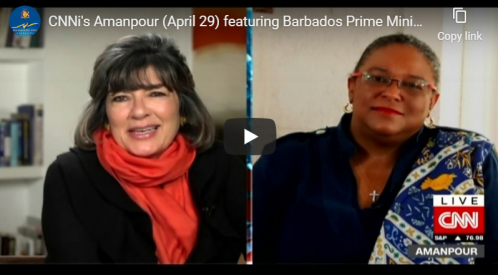
Jason Cotton, Jan Yves Remy and Alicia Nicholls$*All of Barbados sat glued to their television sets this Wednesday as CNN’s Christiane Amanpour interviewed Prime Minister, the Honourable Mia Amor Mottley. And she did not disappoint. She used the world stage to make a clarion call for global leadership on the issue of vulnerability and revived the concept of a Vulnerability Index for validating small States’ claim for special treatment in international relations.
As the Prime Minister noted, vulnerability has been the subject of international trade literature for years, and the Commonwealth Secretariat has pioneered work on vulnerability. More recently, we at the University of the West Indies’ Shridath Ramphal Centre…