



CARICOM’s Stake in the WTO Director-General Race
Alicia Nicholls$*Incumbent World Trade Organization (WTO) Director-General (DG) Mr. Roberto Azevedo’s recent announcement of his resignation a full year before concluding his second term of office took the world by surprise, and presents another plot twist among the mounting challenges confronting the guardian of the multilateral trading system. The incoming DG – whoever he or she may be – faces the herculean task of tackling these challenges head on in an atmosphere of growing protectionism, the COVID-19 pandemic and deafening calls for WTO reform.
This SRC Trading Thoughts offers a Caribbean perspective on the on-going DG race at this critical juncture in the WTO’s history and why Caribbean Community (CARICOM) Member States have a vested interest in this process and its outcome.
SRC Report on E-Commerce-Related Policies, Initiatives & Legislation Across CARICOM

E-commerce is a US$ 29 trillion market with long term gains especially for developing countries. The SRC recognises the pivotal role that e-commerce can play in the Caribbean’s economic growth and sustainable development. Therefore, we have compiled this Report to sensitize readers about the existing e-commerce related policies, initiatives and legislation across the Caribbean Community (CARICOM). It is our hope that these initial insights will inspire further e-commerce related research and policy initiatives across CARICOM. Read the full report here!
Recording of Webinar series exploring the Multiparty Interim Appeal Arbitration Agreement (MPIA)
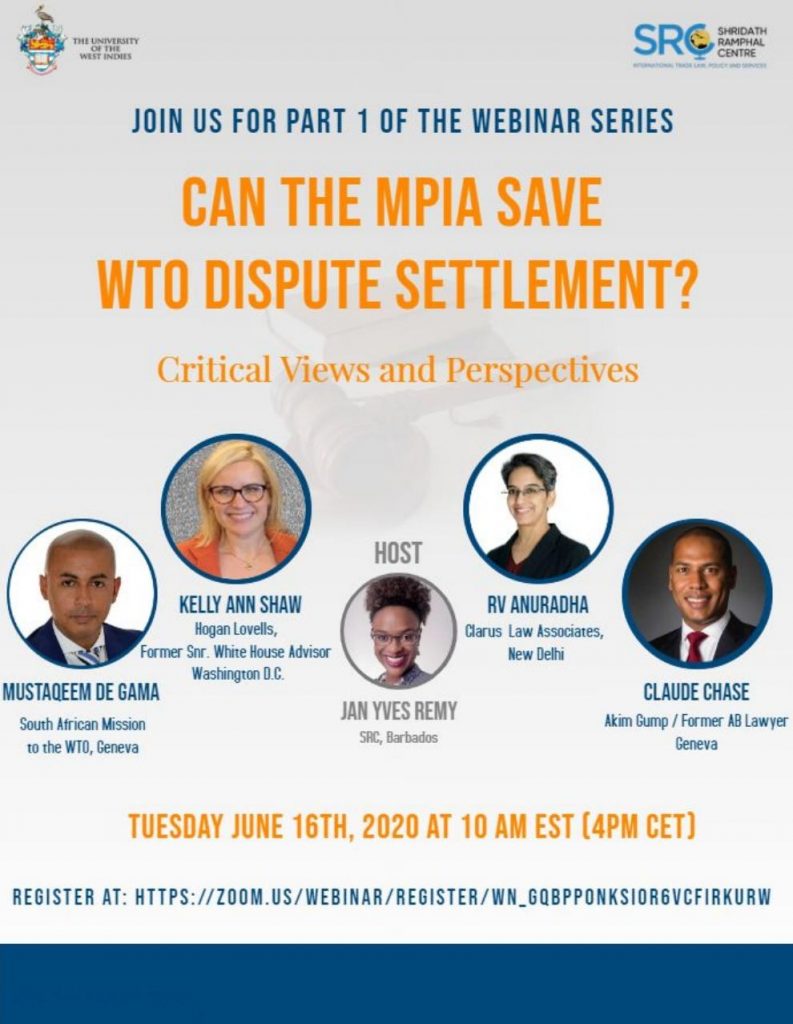
On June 16, 2020 the SRC held the first part of a webinar series exploring the Multiparty Interim Appeal Arbitration Agreement (MPIA, an interim agreement put forward by a group of WTO Members to temporarily address the paralysis at the WTO’s Appellate Body (AB). While its proponents highlight its most attractive features including its preservation of the WTO’s two-tier binding legal system, most WTO Members still have not signed up to it and remain curious about the impact of the MPIA on the future of WTO dispute settlement, and the WTO generally. Watch the recording here:
Lessons from the Appellate Body’s Parting Shot in the WTO Tobacco Plain Packaging Dispute

Dr. Jan Yves Remy$*The report issued this week by the Appellate Body of the World Trade Organization (WTO) in the Australia Tobacco Plain Packaging dispute might be remembered because it is the final report of a dying international appeal court. However, to focus on its symbolic value only would be a missed opportunity to learn key lessons from one of the largest disputes ever litigated at the WTO.
And what are these valuable lessons? First, by upholding Australia’s right to regulate public heath through its tobacco control measures, the Appellate Body elevated “health” over “trade” at a time when an unprecedented global pandemic is crippling the world economy. Second, th…
CCJ Issues Declarations Against CARICOM and Barbados but Cement Tariff Increase Stands

In a judgment released today, the Caribbean Court of Justice (CCJ) upheld the decision of the Council for Trade and Economic Development (COTED) to raise the tariff on “other hydraulic cement” imported into Barbados. The CCJ declared, however, that the Caribbean Community (CARICOM) and Barbados failed in their respective duties to conduct prior consultation with the importers, Rock Hard Cement Limited (“Rock Hard”). The Court’s decision was given in the original jurisdiction matter of Rock Hard Cement Limited v The State of Barbados and The Caribbean Community and Arawak Cement Company Limited, Intervening [2020] CCJ 2 (OJ). Access the full media release on the CCJ’s website here.
RE-IMAGINING BARBADIAN TRADE POST COVID-19, PART 1
By Ade Oneal The global coronavirus pandemic has forced us to rethink the way we operate, while bringing to the fore the inefficiencies in the way “we do business.” I will not belabour the point that we are heavily reliant on tourism or importing far more than we need and export in this article, rather I will focus on our response to the pandemic and suggest areas where we are to reimagine our trade. The initial policy response to the pandemic was primarily concerned with maintaining public health and access to critical supplies. Our response widened to include mitigating the economic fallout while preparing for recovery. These policy interventions included vat and other tax referrals, moratoriums on loans and interest, increasing the capacity of social security systems to counteract displacement of workers and business owners. Earlier this week, Parliament passed legislation to provide support for entrepreneurs, the week prior we learned of forced savings to support businesses. Missing from the discourse to date however has been the need for an export strategy to support our standard of living. We have reached the juncture where we can no longer ignore the cultural shift & business support required to maintain our standard of living. This is why a Comprehensive Export Programme is needed. This programme should be developed in a way which improves welfare of society by reducing costs associated with the provisions of goods and services, maximising our foreign exchange earning capacity while having capital available for investment in strategic sectors. Considering businesses trade (not countries/governments), this programme should ideally be led by the Private Sector, (recall they benefited from tax breaks in 2018, 2019 and further concessions in 2020) and supported by the Government so as to realise greater exports of Barbadian goods and services. The Private Sector, responsible for finding innovative ways to remodel their businesses to support an export strategy/internationalisation and Government providing an environment which encourages innovation. Working in tandem we would be able maintain the standard of living that we have grown accustomed to. Over the course of two articles, I will draw attention to two sectors which I believe have the capacity and wherewithal to lead this transformation. This week, I will focus on Agriculture. In 2016, The Inter-American Development Bank estimated that this industry contributes 3.8% of our GDP and 2.9% of jobs. Most Barbadians can agree that there is room for greater contribution. This article will give examples on the how. Agriculture Players in this industry often lecture Barbadians about their ability to satisfy local demand for fresh meat and produce. In fact, ever so often I am haunted by the words of the head of the Barbados Agricultural Society, reiterating this ability. After decades of these pronouncements, the time is ripe for this industry to look beyond the market of 280,000 people and diversify to also focus on providing inputs for secondary and tertiary agricultural products while removing the colonial stain of prioritising low value products. This industry is ably supported by a wide array of incentives including export promotion, access to concessionary finance and land, market research through the Barbados Agricultural Development and Marketing Corporation, subsidies for investment in modern techniques and others too many to name. I concede that praedial larceny, if not addressed by legislative action and the adoption of modern technologies will frustrate the industry. I also acknowledge the difficulty in competing with countries with large land space that affords farmers to spread costs over larger yields. I am convinced however that once we resist the lobbying efforts of the ‘cartel’ who guarantee their profits at our expense, and direct them to mitigating strategies, the sector’s profits can be maintained (and increased), as a result of a thrust towards exportation as well as the incorporation of a modern business ethos which accounts for the diversification of products. (A success story is the BADMC’S Carmeta brand) Diversification allows for the reduction of imports of some of the secondary products, increasing exports in the medium- long term, updating our manufacturing plants to international standards while supporting the creation of meaningful employment. Similar investments can be made across all sectors where primary production is the sole focus, yielding similar benefits, e.g Consider the Blue Economy where a new fisheries policy is currently being contemplated. Can we not consider processing canned flying fish, sea salt and shell scrubs? In pursuit of these goals, government should provide legislative support to address praedial larceny. A review of the tariff regime governing agriculture should swiftly follow to incentivise the industry to act with haste. For too long the government has been complicit in supporting a lethargic approach by members of this cartel through maintaining a high tariff; 216% for some seasonings, 184% for poultry, 160% for some ground provisions, 141% for milk! Overall, we pay a markup of ⅓ for agricultural products in duties alone! This of course does not include the other markups that importers invariable add. Changes to this regime will require innovative approaches and better regulation considering our cultural dynamics and the limited land space available to us. A perfect example was seen recently by the ‘chicken cartel’. Stakeholders were clamouring for reprieve as a result of increased stock levels as a result of closure of businesses. This resulted in the Barbados Agricultural Development and Marketing Corporation halting the importation of chicken, notwithstanding that the profits support the operations of the entity. We were promised reductions in chicken prices, however the reductions are left wanting. An appropriate alternative in this instance would have been to amplify efforts to find new markets while allowing the local market to regulate itself without the intervention of the Government. This would result in improved welfare as society benefits from competitive prices, producers benefit from new markets and increased profits, government benefits from tax revenue, coupled with profits from their Enterprise. Recalling examples from Jamaica and the Eastern Caribbean (where businesses were forced to adapt to open markets as a result of the cessation of protective regimes), I anticipate there will be significant pushback. However this industry can not continue ‘playing safe’ while ignoring the need to be competitive and innovative
COVID-19 Is Exposing Cybersecurity Vulnerabilities

Chelcee Brathwaite$*COVID-19 is shifting more activities to online platforms: from board meetings to classrooms, to church services, to local vendors, all are moving online as a result of new social and physical distancing measures. Reports indicate that since the pandemic began, web conferencing has grown by 500%, video platforms by 265%, webinars by 226% and live chats by 194%. E-commerce too has grown as shoppers are being forced to conduct transactions online. While these developments represent a win for the digital economy, a darker underbelly is also growing as cybercriminals capitalize on the increase in online activity.
Perhaps you’ve heard of ‘zoombombing’ a term recently coined to refer to unwanted intrusions of racial slurs, pornographic content and other discrim…
SRC alumna authors article on Contract breaches and penalties amidst COVID-19

Shalisha Samuel, a UK barrister and an alumna of Cohort 5 of the SRC’s Masters in International Trade Policy (MITP) programme, has authored an article on contract breaches and penalties amidst the COVID-19 pandemic. The article was published in the Monday, June 1, 2020 edition of Barbados’ leading business magazine, the Barbados Business Authority. The full article may be accessed below: Read more at http://businessauthority.brb.newsmemory.com/
Geopolitically Investigating The Flight Plan For Caribbean Integration: The Case Of LIAT

Dr. Kai-Ann Skeete$*Given the Caribbean’s natural geography, air transportation is a critical component of our regional infrastructure. The Caribbean is heavily reliant on air-transportation to provide connectivity which is fundamental to sustaining economic growth in a region highly dependent on trade in goods and services, especially tourism. However, several CARICOM leaders have chosen not to rally behind LIAT and fail to see the importance of LIAT to the successful functioning of their economies.
As I write this, the region is in unchartered territory and is battling with what geopolitical strategists call wildcard events. Wildcard events are essentially the improbable e…
CARICOM makes statement on COVID-19 Trade-related Measures at WTO General Council Meeting

The Caribbean Community (CARICOM) delivered a statement on COVID-19 Trade-related Measures at the Special Virtual Meeting of the World Trade Organisation (WTO) General Council held May 15, 2020. The statement was made by the Permanent Delegation of the Organisation of Eastern Caribbean States (OECS) to Geneva on behalf of the CARICOM Group. The full statement may be accessed here.