



Engaging the Caribbean Diaspora for Trade and Sustainable Development

Alicia Nicholls$*Some four million people of Caribbean descent live outside of the region, according to data from the United Nation’s Population Division. Persons of Caribbean descent can be found across the world, but their main hubs are in the United States (US), the United Kingdom (UK), Canada and parts of continental Europe, such as France and The Netherlands. With regard to emigrant stock as a percentage of their national populations, the percentage for Caribbean countries in 2013 varied from as ‘low’ as 11% in the Dominican Republic to as high as 103% for the Commonwealth of Dominica.
2020 New Year Message – CARICOM Chairman, Prime Minister Mia Mottley of Barbados
“People of the Caribbean Community, it is with a sense of immense pleasure, pride and humility that I greet you at the start of the new year, as the new Chairman of CARICOM. Across our region, 2019 has brought more than its fair share of challenges, and indeed many of them, including the very daunting prospects of the climate crisis, are certain to follow us into this New Year. But as we enter 2020, with no thought of defeat — we do so conscious that long before terms such as resilience and sustainable development were fashionable, we saw ourselves and we knew that we are a resilient people who for centuries have battled adversity of every kind, and we have always prevailed. Our very history has been one of struggle but one of success! It is against this backdrop that we can take a fresh look at the path we would wish to set for ourselves and our children, using a term that is no doubt familiar to us all. It is my sincere wish that our approach to the advancement of our people in every country of the Caribbean Community would be characterized by a level of clarity that is usually associated with 2020 vision. For generations, the actions and the experiences of ordinary men and ordinary women of the Caribbean have left no doubt that they have always known what they have wanted for the inhabitants of these islands. And we are no different today. In fact, many of us have demonstrated what true integration really means, in spite of the obstacles of bureaucracy that we sometimes confront in our leadership class as we go about our ordinary business. But at the same time, we recognise that the regional integration movement is very much a relay race. Sometimes we are hard on ourselves, expecting to achieve overnight that which requires patience and careful nurturing over generations. Our vision to better the lot of our people has remained constant — from the very early days of the Montego Bay Conference in 1947 on Closer Association of the British West Indian Colonies, to the West Indian Fédération of 1958 to 1962 most ably led by the founder of my own political party, the Right Excellent Sir Grantley Adams. From the establishment of CARIFTA on December 15, 1965 – ten weeks after I was born – at Dickenson Bay in Antigua, to its transformation into the Caribbean Community, the institution we now know, the document signed on July 4, but coming into force on Emancipation Day, August 1, 1973 at Chaguaramas in Trinidad, or to the 1989 Grand Anse Declaration in Grenada that signaled our determination to remove the disadvantages of size and geography from our national development through the commitment to establish the Single Market and Single Economy. Our process has therefore been one that has moved from generation to generation of committed Caribbean people, to the building of a regional integration movement that will allow us always to work to provide the best lives possible for our people. Lest we be influenced by those who would only see a half empty glass, rather than one that is half full, may I remind us all that the European integration movement started on April 16, 1948 so as we enter the third decade of the 21st century they too are still working to perfect that union, despite having far more resources than we have ever had in the Caribbean. I pray, therefore, that 2020 will strengthen us to run our leg of this regional integration relay race with confidence. I pray that as leaders of the Caribbean Community we will work to give our people renewed confidence and inspiration to help us run this leg, while staying focused on achieving the next phase of critical progress. And what is that next phase? We are duty bound to continue this journey across the Community whether as a collective of the whole or in twos and threes where we are gathered in a way that will: Remove the obstacles to passport-free movement between our nations;Make it easier for Caribbean people to go and work where there are opportunities in the Community in a way that is hassle-free in the same way that we have done it for the movement of capital. In keeping with our own Errol Barrow’s vision, the reality of our people must not only be a lived reality but also a legal reality. The Caribbean Community must lead the world in shaping an environment within which migrants among us can live and work with dignity. After all, our modern settlement in the Caribbean has been nothing but that of a community of migrants;Truly advance the process of a single domestic space for transport and communications in the region by working to provide more affordable and reliable air and sea links between our countries and also to establish a single domestic rate for telecommunications and phone calls within CARICOM;Work with the private sector and the labour movement to provide further opportunities beyond transport and communications mentioned above, to food security, to opportunities in the blue economy or renewable energy and ICT for our people – opportunities for investment and for employment;Enable us as we face the climate crisis, to pool the funds of the region in order to be able to finance our own development trajectory for sustainable development so that we may adapt to the new realities of the climate crisis. This will require us coming up with innovative instruments that will better allow us to access the capital that we are not now accessing at a global level. Let us remember that those who help themselves will always be helped by others but we must help ourselves first by pooling our own resources.My message, in essence, is that 2020 can and must provide the platform for a positive spirit of hope and optimism and a fierce determination to come together as Caribbean people to purposefully carry forward the transformation of our region into a space that truly values, nurtures, and provides concrete opportunities for every Caribbean
UWI Strengthening Canada-Caribbean Relations

Regional Headquarters, Jamaica, Friday, 13 December 2019—Vice-Chancellor of The University of the West Indies (The UWI), Professor Sir Hilary Beckles is pleased to announce that the proposal for the establishment of the Canada-Caribbean Institute (CCI) was approved at a meeting of the University Finance and General Purposes Committee UFGPC) on October 30, 2019. The new Institute, which is a collaboration with Brock University in Canada, will provide multi-disciplinary research and teaching to deepen and improve the relations between Canada and the Caribbean, and serve to examine issues affecting the Caribbean diaspora communities in Canada. Discussions on the establishment of the Institute began earlier this year following the signing of an agreement between Vice-Chancellor Beckles and President and Vice-Chancellor of Brock University, Gervan Fearon, (the first Caribbean descendant to head a Canadian University Canada). It is anticipated that The UWI and Brock University have both completed their approval processes for the establishment of the CCI by early 2020 and will jointly mount a three-day Canada-Caribbean Research Symposium in February 2020. The CCI’s mission more specifically, seeks to build upon and revitalize existing partnerships, while forging new ones among Canadian and Caribbean tertiary education institutions, government agencies and civil society. Included among examples of planned activities for the Institute are cooperation and exchange among faculty, students and other persons interested in Canada-Caribbean relationships; facilitating the formation of partnerships, the co-production and sharing of knowledge, development of joint programmes, and hosting of conferences and seminars. The need for an institute dedicated to Canada-Caribbean studies is based upon recognition that despite the importance of Canada-Caribbean relations there has been limited research in this area and no entity dedicated to its study. Canada and Caribbean countries have had relationships dating back hundreds of years in a variety of areas, such as trade, investment, security cooperation, development assistance, diplomatic relations and many countries of the Caribbean having been colonies of Britain, have a legacy of a shared language, common institutions, culture affinities and experienced history. Thousands of Canadians vacation annually in the Caribbean; there is an extensive Caribbean diaspora in Canada, temporary workers from the Caribbean are engaged seasonally in agriculture and hospitality, and many citizens of the Caribbean further their studies at colleges and universities in Canada. According to Pro Vice-Chancellor, Global Affairs, Ambassador Dr. Richard Bernal “Canada has been the Caribbean’s most empathetic and consistent development partner and hence an assured complacency has set in and it is time to reinvigorate the partnership while consolidating the existing foundations”. The CCI is the latest addition in a cluster of international centres launched by The UWI. It demonstrates another tangible implementation of the regional university’s thrust to globalize; a key objective framed within its Triple A Strategy (Strategic Plan 2017-2022). This focus, in fact, earned The UWI recognition in the Times Higher Education World University Rankings in 2019 and 2020 for its international outlook which placed it among the top 10% of universities world-wide in this category.
SRC Deputy Director’s Interview with Choice TV on WTO Appellate Body Crisis
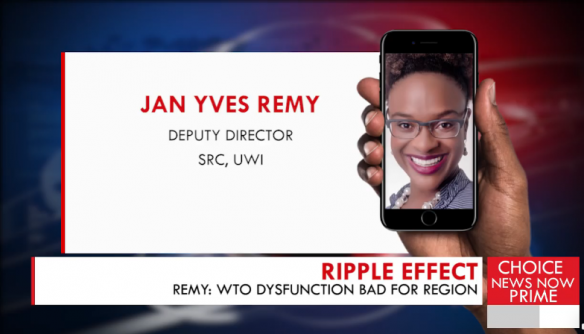
SRC Deputy Director, Dr. Jan Yves Remy, spoke with Choice TV’s Janeka Simon about how exactly the collapse of the WTO Appellate Body could impact every day life in Saint Lucia and the wider region. Dr. Remy is an expert in WTO Law. She worked with the Appellate Body for six years as a dispute settlement attorney. Watch the full interview here!
A Perspective on Caribbean Post-Cotonou Negotiations

By Junior Lodge Current Atmospherics The African, Caribbean and Pacific (ACP) Group and European Union (EU) began negotiations in September 2018 to replace their current Cotonou Partnership Agreement (CPA) that expires on February 29, 2020. These negotiations – often referred to as the “Post-Cotonou negotiations” – have yielded significant progress as can be gleaned from the existence of stabilised texts. Notwithstanding the progress already made a series of outstanding differences remain while substantive treatment of additional areas in the negotiations are yet to commence. In this context, negotiations are unlikely to be concluded in time for the March 1, 2020 deadline and accordingly, transitional arrangements are being crafted to legally extend application of the CPA to December 31, 2020. Post-Cotonou negotiations are being impacted by a number of global, EU- and ACP-specific factors. First, notwithstanding the recent conclusion of global agreements, multilateralism remains severely challenged as can be evinced from rising political weight of nationalist cum populist parties in the EU. In this context, signs of a sustained realignment of EU trade and development policy should be closely tracked. A number of EU Member States failed to sign the UN Global Pact on Migration while others concluded bilateral agreements with select third countries to repatriate African migrants. These are only two recent examples of the EU’s failure to fully embrace multilateralism. Second, the EU’s main objective in forging a post-Cotonou relationship with the ACP remains that of overturning the traditional donor-client relationship. The EU had signalled a shift in its development policy in the 2018 EU Council decision on Overseas Countries and Territories which noted, inter alia, the “special relationship between the Union and OCTs is moving from a development cooperation approach towards a reciprocal partnership to support OCTs’ sustainable development.” The following extract from the EU negotiation mandate for post-Cotonou negotiations is instructive – “[t]he Parties will cooperate to create an enabling economic environment to significantly increase the level of sustainable and responsible investment flows to their mutual advantage”. That statement stands in stark contrast with the stated objective of the CPA “to promote and expedite the economic, cultural and social development of the ACP States”. Third, the ACP is facing a major existential challenge as evinced by both the review of the Georgetown Agreement that established the Group in 1975 and the thrust of post-Cotonou negotiations. The ACP is seeking to transform itself into an intergovernmental organisation, develop relationships beyond the EU by forging partnerships with BRICs, promote South-South and triangular cooperation and position itself as the leading global advocate for development policy. Allied to this, the current crafting of EU regional protocols with the three constituent regions, i.e. Africa, Caribbean and Pacific constitutes a radical realignment of its relationship with the ACP. ACP Group efforts to reinvent itself should be framed by Africa’s stated objective of forging its own relationship with the EU, independent of the longstanding Lomé/Cotonou framework. Africa’s political stance is strengthened by recent developments, most notably, the conclusion of the African Continental Free Trade Area, establishment of an African peace and security architecture resulting in AU field operations in Somalia, Sudan, Comoros and Central African Republic, and sustained economic growth that could result in a US$2.6 trillion continental economy by 2020. Fourth, the United Kingdom’s withdrawal from the EU (i.e. BREXIT) tempers the value of the Caribbean-EU partnership. The UK remains the export destination in the EU for most CARIFORUM States. For example, UK merchandise imports from Grenada, Guyana and Jamaica in 2017 were 97.2%; 63.5% and 76.6%, respectively and therefore the commercial value of the CARIFORUM-EU Economic Partnership Agreement (CEPA) will significantly decline after Brexit. In addition, the UK’s prospective exit from the EU would dispossess the Caribbean of its main ally within the EU given the UK’s support during the longstanding EU-US dispute on bananas, and more recently on securing advanced commitments for Caribbean services suppliers to access the EU market under the CEPA. BREXIT will also diminish the value of the CARIFORUM-EU partnership given the fact that 5 of the 16 EU territories in the Caribbean are British. The shared CARIFORUM-EU objective of strengthening trade and functional cooperation with the EU overseas territories and OCTs will be negatively impacted by BREXIT. Negotiation Process and Results Post-Cotonou negotiations have been structured into two distinct phases. The first phase seeks to treat with All-ACP-EU issues with results to be captured in a Foundation Agreement. The All-ACP-EU negotiations addresses overarching themes defining the relationship such as General Provisions, Strategic Priorities, Means of Cooperation, International Cooperation, Institutional Framework and Final Provisions and would be applicable to all signatory states. The second phase centres on the negotiation of regional protocols with the three constituent regions of the ACP. The conclusion of these EU protocols with Africa, Caribbean and the Pacific would allow for the centre of gravity of ACP-EU relations to be shifted to regional partnerships. The three regional protocols will be annexed to the Foundation Agreement to constitute a single, legally binding ACP-EU Partnership Agreement. Negotiation of the Foundation Agreement Negotiation of the Foundation Agreement has thus far resulted in the emergence of stabilised texts on most of areas of the Strategic Priorities. More specifically, advanced texts have emerged on Human Rights, Democracy and Governance in People Centred and Rights-based Societies (Title I); Peace and Security (Title II); Human and Social Development (Title III); Inclusive Sustainable Economic Growth and Development (Title IV); and Environmental Sustainability and Climate Change (Title V). A series of negotiations has been conducted on Migration and Mobility (Title VI) with initial exchanges held on General Provisions; Global Alliances and International Cooperation; Development and Means of Implementation; Institutional Framework and Final Provisions. The existence of stabilised text in the Foundation Agreement notwithstanding, considerable differences remain on a number of salient issues. For example, the ACP objects to the reference under Title I (Human Rights, Democracy and Governance in People Centred and Rights-based Societies) obliging Parties to “promote and respect sexual orientation and gender identity”. Also under that title, ACP proposed language
SRC Director’s Christmas Greeting 2019

Hello, I am Neil Paul, Director of the SRC. It is my pleasure to bring you Christmas greetings on behalf of the SRC Team. 2019 has been a big year for us at the SRC. We welcomed the 16th Cohort of our flagship Masters in International Trade Policy (MITP) programme. We also undertook a major rebranding exercise. This culminated in our Open Day where we unveiled our new logo and rebranded SRC website: www.shridathramphalcentre.com. We published 18 Trading Thoughts articles which were carried in the local and regional media and on our social media networks. Some of the topics included agriculture, food security, WTO reform, e-commerce, Caribbean-China and Caribbean-Africa relations, to name a few. The authors included SRC staff members and some external contributors. We hosted 7 SRC Lunch Time Chats for the year. The topics were: inclusionary governance reform; special and differential treatment at the WTO; the Eastern Caribbean Central Bank Digital Currency Pilot; UNCITRAL Investor-State Dispute Settlement Reform; the Caribbean Court of Justice at the centre of regional integration; natural disasters and trade and the promise of blockchain for the region. We co-hosted the latter with the IDB. We commenced a new interview series called SRC One on One Chats. We also started our monthly SRC Newsletter, and continued publication of our alumni publication ‘Trade N’Spaces’ Insights. We hosted a four-part series titled Talking Trade – The Caribbean at the WTO, in partnership with UWITV. The interviewers were myself, Neil Paul, and Dr. Jan Yves Remy. MITP alumna Jeanelle Clarke, then a WTO intern, was the co-host of the series. The interviewees included: Ambassador Chad Blackman, Permanent Representative of Barbados to the United Nations and the WTO; Emmanuelle Ganne, Counsellor, WTO; Michael Roberts, Aid for Trade Coordinator, WTO and Stephen Fevrier, Head of Mission and Charge d’Affaires of the OECS Permanent Delegation in Geneva. We partnered with several local and international partners to hold four major public events: In association with the Barbados Ministry of Foreign Affairs and Foreign Trade, A public lecture given by Dr. Mukhisa Kituyi, Secretary-General of UNCTAD on “The Role of UNCTAD on Trade and Development in the Caribbean” The SRC also hosted a lecture by the Rt. Hon Professor Owen Arthur on “Brexit and The New Caribbean Trade Agenda”, in collaboration with the ACP Secretariat, CARICOM Institute for Pan-African Thought and Conversation (PATC) and the University of Johannesburg, at the SAGICOR Cave Hill School of Business and Management Another of our public events was “An Evening Chat with Women Shaping Global Economic Governance and Trade” with the International Trade Centre, in collaboration with the International Trade Centre. We also co-hosted a symposium entitled “Exploring New Horizons in Caribbean-China Trade and Investment Relations” with the Confucius Institute, the Sir Arthur Lewis Institute of Social and Economic Studies (SALISES) and the Faculty of Law. The SRC also teamed up with The UWI Faculty of Law at Cave Hill to bring the first Tradelab legal clinic to the Caribbean region. We are proud to report that we have passed the pilot phase and are now a full member of the Tradelab network! All of these activities would not have been possible without the support of our dedicated staff at the SRC including Dr. Jan Yves Remy, Dr. Kai Ann Skeete, Miss Alicia Nicholls, Mrs. Clauzel Forde, Mrs. Desiree Evelyn, Mrs. Tameshia Brandford and Mr. Andre Maynard. In addition, we thank you, our colleagues, for your continued support of our work and outreach efforts. And we look forward to your continued support next year. On behalf of the SRC team here at Cave Hill, I wish you and your families a Merry Christmas and our best wishes for 2020. Merry Christmas to one and all!
SRC Year in Review – 2019
UNCTAD 15 Dates Announced!
The dates of the UNCTAD 15 quadrennial have been announced! According to a press release from UNCTAD – the United Nations body responsible for trade and development issues – the UNCTAD 15 ministerial will take place over the week of October 18-23, 2020. It was announced earlier this year that the meeting will take place in Bridgetown, Barbados. For further information, please see the press release from UNCTAD here.
The UWI is Tradelab’s newest member!
We are pleased to announce that the University of the West Indies (UWI) is Tradelab’s newest member! In a recent release in the Tradelab newsletter, it was noted that “after a thorough review by the TradeLab Executive Committee and General Assembly, TradeLab has admitted UWI into its network”. Last semester, 9 students in UWI’s pilot clinic completed 3 confidential projects for different government and IGO beneficiaries, under the leadership of Dr. Jan Yves Remy, Deputy Director of the SRC, and Dr. Ronnie Yearwood, Lecturer in Law, Faculty of Law, The UWI Cave Hill. These projects included: Analysing reform proposals put forth by World Trade Organization (WTO) Members to enhance the organization’s efficiency and functioning; Formulating WTO compliant domestic support options for local manufacturers; and Identifying policy priorities and strategies for the beneficiary to prepare for plurilateral e-commerce negotiations. Additionally, Dr. Remy has recently been elected to Tradelab’s Executive committee. Learn more about Tradelab here.
My Journey South: Tracing developments on Artificial Intelligence (AI) in Latin America and the Caribbean

Chelceé Brathwaite$*While some still consider AI to be beyond the grasp of developing countries, our South American neighbours have been shattering that stereotype. AI is being deployed in a number of their endeavours: to speed up artefact findings in Peru; to increase crop yields in Colombian rice fields through AI-powered platforms; to boost security and enhance customer service in Brazil’s banking sector; to create vegan alternatives with the same taste and texture as animal-based foods in Chile’s food industry; to predict school dropouts and teenage pregnancy in Argentina; and …