


Conference Call for Proposals: Teaching International Law

A group of international law teachers have formed an Organising Committee to convene a British Institute of International and Comparative Law conference on Teaching International Law. The Organising Committee invites all those engaging with the teaching of international law from around the world to share their experiences and critically reflect on current practices of teaching international law. The aim is to foster reflection and discussion amongst the plurality of actors that teach international law across different contexts, traditions, and perspectives. Reflections may focus on general courses of international law or more specialised courses – including courses concerning particular branches of international law (e.g. environmental law, investment law, trade law, human rights law, humanitarian law, or international criminal law) or cross-cutting themes (e.g. non-state actors, inequality, technology). Read the call for proposals.
SRC Deputy Director and UWI Faculty of Law Deputy Dean participate in ASIL-IEcLIG Biennial Conference 2020

Deputy Director of the SRC, Dr. Jan Yves Remy, attended the ASIL-IEcLIG Biennial Conference 2020 from February 14-15, 2020, at the University of Miami School of Law. Also on the panel was Deputy Dean of the Faculty of Law of The University of the West Indies, Cave Hill, Nicole Foster. The conference, whose theme was ‘Designing International Economic Law: Challenges and Opportunities”, is one of the premier conferences bringing together international trade lawyers. Dr. Remy chaired Panel A of Session 3. The panelists and their topics were: Nicole Foster (University of the West Indies), “Unhealthy Diets and Front of Pack Labelling Schemes: The New Battleground on Regulatory Autonomy under the TBT Agreement” Shin-yi Peng (National Tsing Hua University), “One Measure, Two Regimes: Autonomous Vehicle Regulations as a Case Study on the Goods-Services Dichotomy under the WTO Law” Shilpa Samplonius (Global Economics and Management (GEM), University of Groningen), “The Dispute Initiators of the GATT and the WTO: Lessons for the Future to Improve Accessibility, Sustainability, and Relevancy of the WTO”. Photo: Dr. Jan Yves Remy (right) with panelist and Deputy Dean of the Faculty of Law, The University of the West Indies, Cave Hill, Nicole Foster (left).
Communique from 31st Intersessional Meeting of CARICOM Heads of Government

COMMUNIQUÉ ISSUED AT THE CONCLUSION OF THE THIRTY-FIRST INTER-SESSIONAL MEETINGOF THE CONFERENCE OF HEADS OF GOVERNMENTOF THE CARIBBEAN COMMUNITY,18-19 FEBRUARY 2020,BRIDGETOWN, BARBADOS(CARICOM Secretariat, Turkeyen, Greater Georgetown, Guyana) The Thirty-First Inter-Sessional Meeting of the Conference of Heads of Government of the Caribbean Community (CARICOM) was held in Bridgetown, Barbados, 18-19 February 2020. The Prime Minister of Barbados, the Right Honourable Mia Amor Mottley, Q.C; MP, Chaired the proceedings. Other Members of the Conference in attendance were: Prime Minister of Antigua and Barbuda, Honourable Gaston Browne; Prime Minister of The Bahamas, Honourable Dr. Hubert Minnis; the Honourable Roosevelt Skerrit, Prime Minister of Dominica; Prime Minister of Grenada, Dr. the Rt. Honourable Keith Mitchell; Premier of Montserrat, the Honourable Easton Taylor-Farrell; Prime Minister of St Kitts and Nevis, Dr the Honourable Timothy Harris; Prime Minister of Saint Lucia, Honourable Allen Chastanet; Prime Minister of St. Vincent and the Grenadines, Dr. the Honourable Ralph Gonsalves; and Prime Minister of Trinidad and Tobago, Dr. the Honourable Keith Rowley. Belize was represented by the Minister of Foreign Affairs, Honourable Wilfred Elrington; Guyana was represented by the Minister of Foreign Affairs, Honourable Dr Karen Cummings; Jamaica was represented by Minister of Foreign Affairs and Foreign Trade, Senator the Honourable Kamina Johnson-Smith; and Suriname was represented by the Vice President, His Excellency Michael Adhin. Associate Members in attendance were: Bermuda represented by the Honourable Walter H Roban, Deputy Premier and Minister of Home Affairs; the British Virgin Islands represented by Premier, the Honourable Andrew Fahie; and the Turks and Caicos Islands, represented by Premier, the Honourable Sharlene Cartwright-Robinson. OPENING SESSION Secretary-General of the Caribbean Community, Ambassador Irwin LaRocque, immediate past Chair of the Community, Prime Minister of Saint Lucia, Honourable Allen Chastanet and Chairman of the Community, Prime Minister of Barbados the Right Honourable Mia Amor Mottley, Q.C; MP addressed the Opening Session. Foreign Minister of Canada the Honourable Francois-Phillipe Champagne and Secretary-General of the Commonwealth, Baroness Patricia Scotland attended the Opening Session The speakers emphasised the need for the Community to act in concert in order to overcome the challenges posed both within and from outside of the Region. The theme of CARICOM “as a family’ threaded through the presentations, along with praise for the regional institutions led by the Caribbean Public Health Agency (CARPHA), and the Pan American Health Organisation (PAHO), as well as the CARICOM Secretariat for the co-ordination of the response to the Coronavirus. The text of the speeches is available at www.caricom.org. In a short ceremony, the Honourable Dr Hubert Minnis, Prime Minister of The Bahamas thanked the people of the Region, and in particular, the schoolchildren of Barbados for their assistance after the passage of Hurricane Dorian. The Prime Minister expressed appreciation for the donation of money, books and clothing to Bahamian school children by their counterparts in Barbados representatives of whom were present at the Opening Session. AGREEMENTS SIGNEDDominica (i) Protocol on Public Procurement and Declaration of Intent to Provisionally Apply the Protocol on Public Procurement(ii) Agreement on the Return or Sharing of Recovered Assets and Declaration of Intent to Provisionally Apply the Agreement on the Return or Sharing of Recovered Assets British Virgin Islands(i) Revised Agreement Establishing the CXC (ii) Agreement Establishing the Caribbean Accreditation Authority for Education in Medicine and Other Health Professions St. Vincent and the GrenadinesProtocol on Public Procurement and Declaration of Intent to Provisionally Apply the Protocol on Public Procurement Instruments of Ratification BarbadosAgreement on the Return or Sharing of Recovered AssetsBelizeAgreement Establishing the Caribbean Community Accreditation Agency for Education and Training Instruments of Accession BelizeRevised Agreement Establishing the Caribbean Agricultural Health and Food Safety Agency Memorandum of UnderstandingMemorandum of Understanding between the Caribbean Community and the Government of the United Arab Emirates for the Establishment of a Consultation and Cooperation Mechanism CARICOM SINGLE MARKET AND ECONOMY (CSME) Heads of Government reviewed progress of the CSME, and expressed their determination to increase the pace of implementation taking into consideration the financial and human resource constraints. In that context, Heads of Government welcomed the offer of Barbados to help alleviate the human resource constraint by assigning two persons to assist the Secretariat. Heads of Government also welcomed the offer from Jamaica to provide scholarships to assist Member States in building their Technical and Vocational Education and Training (TVET) capacity. Heads of Government further welcomed the provision of equipment from Jamaica to assist Member States in their efforts to identify easily the security features in the new CSME skills certificate. They also agreed to review the governance structure to make it more supportive of effective implementation. To this end, Heads of Government agreed to hold monthly meetings via video conference. Heads of Government further agreed to establish a Prime Ministerial sub-Committee led by Prime Minister of St Vincent and the Grenadines and including the Heads of Government of Barbados, Belize, Guyana, Jamaica, Saint Lucia and Trinidad and Tobago to review the work of a previous group on issues of implementation, financing and institutional arrangements for governance. The sub-Committee would submit recommendations to the meeting of Conference in July 2020. They recognised that the CSME is at the stage of implementation which requires the active and engaged participation of not only the public sector but all stakeholders including private sector, labour and civil society to ensure continuity and increased effectiveness in policy development and implementation. Heads of Government, in recognising the urgent need to review the strategy for implementation, mandated the Prime Ministerial Sub-Committee on the CSME to develop a Strategy and Programme to address implementation for consideration and approval at the Forty-First Meeting of the Conference in July 2020 for approval. REPORT OF THE COMMISSION ON THE ECONOMY Heads of Government welcomed the Report of the CARICOM Commission on the Economy and the proposed initiatives for building resilient economies and easing the impediments to Doing Business in the Community. Heads of Government engaged in an extensive exchange of views with the Chairman of the Commission and agreed that the Prime Ministerial Sub-Committee on the CARICOM Single Market and Economy (CSME) would consider the recommendations for adoption by the Community. They also agreed that the Caribbean Development Bank (CDB) and the CARICOM Development Fund (CDF) would participate in that
The Art of the US-China Trade Deal

Chelceé Brathwaite$*Over the past 18 months China and the United States of America (US) have been embroiled in a trade
war. That trade war is the result of escalations in tensions surrounding alleged unfair trade practices by China, such as forced technology transfers, currency manipulation and others. By the end of 2019, the USA had imposed tariffs on US$550 billion worth of Chinese goods and China had retaliated likewise with tariffs on US$185 billion worth of American goods. Apart from the repercussions felt by both economies including a sharp decline in bilateral trade, higher prices for consumers and trade diversion effects, this tit-for-tat trade war has proven to be a threat to the global trading system, showing up the shortcomings of the World Trade Organization (WTO) in sanctioning uni
SRC Newsletter February 2020 is out!

Did you know that the SRC has a free monthly newsletter? Have a read of our first edition of the SRC Newsletter for the year. In it, we discuss some of the major changes and events at the Centre and some of our plans for the upcoming year. We have also included our most recent SRC Trading Thoughts article and added our new SRC Trade Quick Guides section. As an added bonus, we have also included a new section called ‘Trade News Watch’. To access our latest newsletter and past editions, please click on the image below:
National Consultations to inform the new Results-Focused 2020 CARICOM Strategic Plan
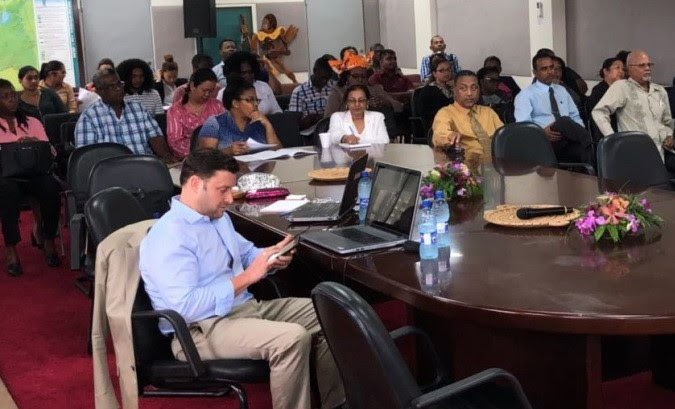
(CARICOM Secretariat, Turkeyen, Greater Georgetown, Guyana) The Caribbean Community (CARICOM) Secretariat is supporting CARICOM Member States and Associate Members to convene broad-based consultations over the period 11 February to 6 April 2019 to inform the development of the Results-Focused 2020 Caribbean Community Strategic Plan. The New Strategic Plan will, among other things, serve to define the direction of the Caribbean Community over the Plan’s horizon; keep implementing partners focused, and lay-out the strategies to secure the future in a dynamic and often challenging global environment. A wide range of stakeholders from the public, private, and the not-for-profit sectors including the Youth, labour organisations, the Media, non-governmental organisations (NGOs), civil society organisations (CSO) and faith-based organisations (FBO) will be consulted on issues related to the regional integration and development agenda. The ‘I AM CARICOM’ Communications Campaign is a component of the process and aims, among other outcomes, to fully engage them in developing and implementing strategic interventions that directly affect their lives. The national consultations are an important part of the process for the development of the Plan, as they are designed to ensure the process is inclusive and consultative. Process for developing the plan At the national level, a National Consultative Working Group (NCWG), chaired by the respective Member State’s Ambassador to CARICOM, has been established in each Member State to lead activities. The NCWG serves as the point of contact for the coordination of input at all stages of the development of the 2020 Results-Focused Strategic Plan. The CARICOM Secretariat is taking a coordinating role in the process to develop the plan. This process was endorsed by the CARICOM Committee of Ambassadors in June 2018 and subsequently approved by the Community Council of Ministers Meeting in the said month. This plan succeeds the first Community Strategic Plan 2015-2019, which ended in December 2019. Benefiting from insights and lessons learned during the implementation period of the first strategic plan, the new plan will be accompanied by a number of other results-focused outputs to support its efficient and effective implementation. These include a costed Results-oriented Community Implementation Plan, Logic Models and Performance Measurement Framework, Community Operational Plan, Risk Management Plan, Resource Mobilisation Plan and Communications Strategy which includes the ‘I AM CARICOM’ Communications Campaign. I AM CARICOM’ Communications Campaign A key feature of the process to develop the plan is the ‘I AM CARICOM’ Campaign (#Iamcaricom), which is currently being rolled out across the Community. This campaign aims to assist the citizens of the Community to understand CARICOM, its people, geography, institutions, governance structure, policies and plan. The Caribbean Community 2020 Results-Focused Strategic Plan, and its accompanying results-focused documents, will be submitted for approval of the Regular Meeting of the Conference of Heads of Government in July 2020, in St. Vincent and the Grenadines.
Trade liberalisation important but not a panacea for the Region
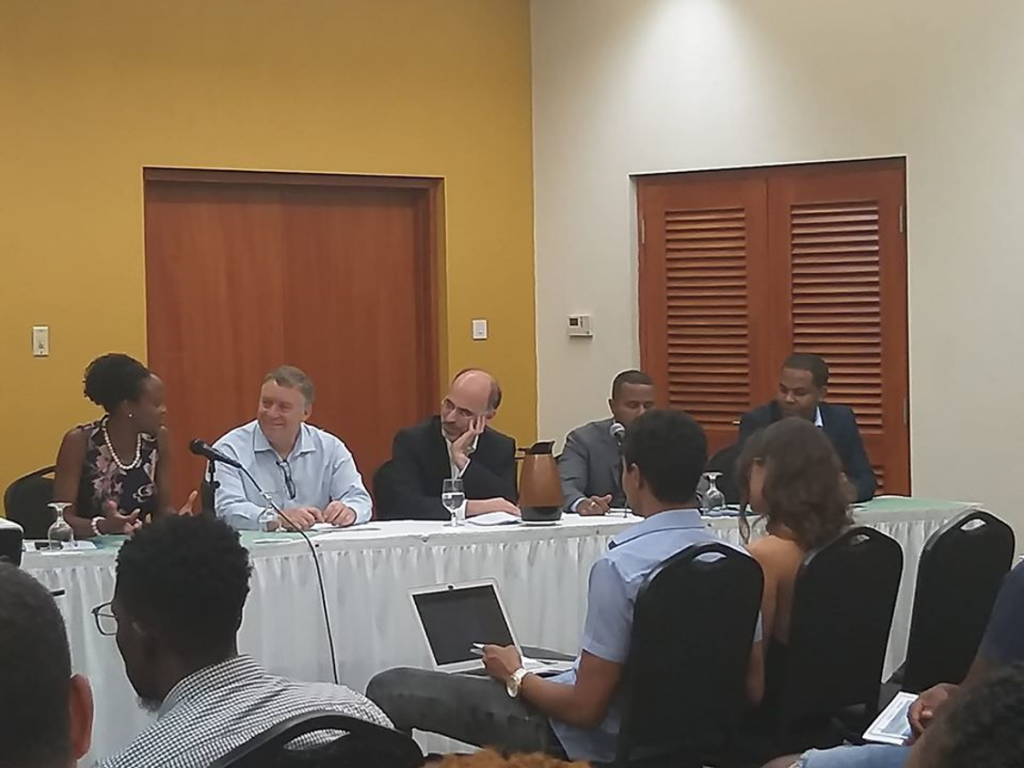
BRIDGETOWN, Barbados – February 7, 2020 – Trade liberalisation is important, but not a panacea for the Latin America and Caribbean (LAC) region. That was the strong message coming out of a panel discussion jointly hosted by the Shridath Ramphal Centre for International Trade Law, Policy and Services (SRC) of The University of the West Indies, Cave Hill (The UWI Cave Hill) andthe Inter-American Development Bank (IDB). The panel discussion took place on Thursday, February 6, 2020 at 6:00 pm at the Sagicor Cave Hill School of Business and Management and carried the same name as the IDB’s 2019 flagship Report on which it was based: “Trading Promises for Results: What Global Integration can do for Latin America and The Caribbean”. In his welcome remarks, SRC Director, Neil Paul, expressed the SRC’s delight in partnering with IDB on this event, noting the intersecting areas of focus of the two institutions, including trade training, research and capacity building. In highlighting the Caribbean’s “disappointing” performance in trade over the past few years, Director Paul noted the anticipation of the audience – largely comprising students and faculty of The UWI, as well as members of the general public – in hearing from the esteemed speakers on whether the promised benefits of trade liberalization for the region had translated into meaningful results. The discussion, which was chaired by SRC Deputy Director, Dr. Jan Yves Remy, began with a presentation by the Report’s two editors Dr. Mauricio Mesquita Moreira (Principal Economic Advisor, IDB Integration and Trade Sector) and Dr. Ernesto Stein (Principal Technical Leader, IDB Research Department). They summarized the report’s major takeaways including that trade liberalization has led to an increase in welfare and economic growth in the LAC region but has not necessarily decreased employment and inequality. LAC governments, they said, needed to implement sound policies that complemented trade ones such as labour adjustment and productivity development programmes. This might help the losers from trade to realise gains. The two discussants – Dr. Justin Ram, Director of Economics of the Caribbean Development Bank (CDB) and Dr. Antonio Alleyne, Temporary Lecturer in the Department of Economics of The UWI, Cave Hill – provided spirited responses to the Report. Dr. Ram applauded its inclusion of political economy considerations, in particular the recommendations for mechanisms to trade adjustment. He implored CARICOM policy makers to not only couch trade in a comprehensive development policy, but to use the single economic space for enabling the free movement of labour and capital. While lauding the effort of the authors in presenting comprehensively the Latin American experience, Dr. Alleyne highlighted the lack of data specific to the Caribbean region. The unfortunate result was that the Caribbean policy-maker could not use the Report to provide a ‘holistic’ picture for formulating and implementing reforms resulting from the dislocations from trade liberalisation. A short and lively discussion with the audience concluded the evening.
SRC/IDB Panel Discussion – Trading Promises for Results
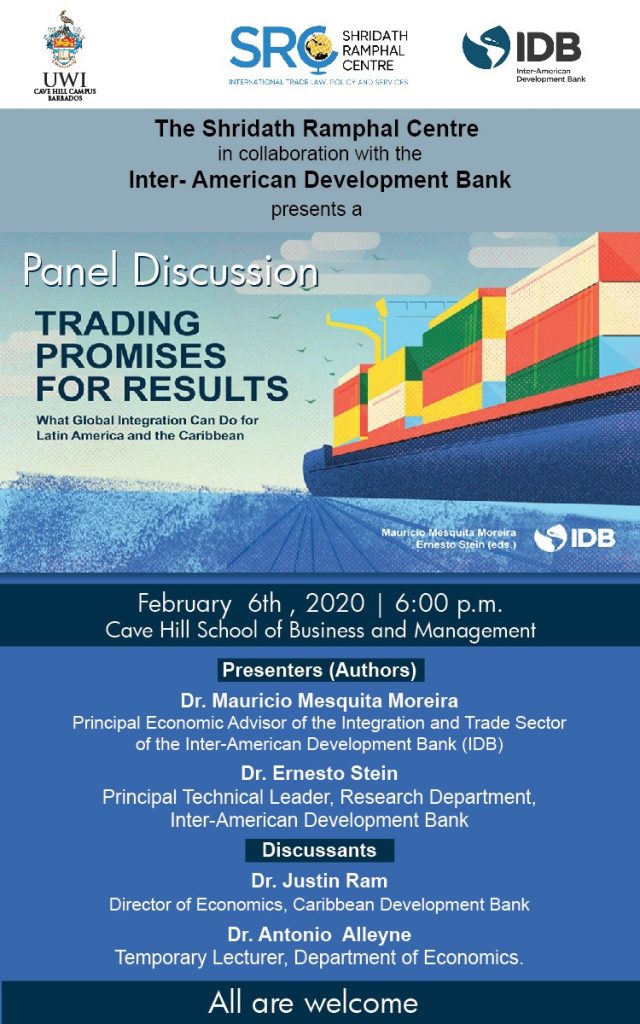
Event Type: Panel Discussion Venue: Cave Hill School of Business Date: February 6th , 2020 Time: 6:00 p.m. Presenters: Dr. Antonio Alleyne, Lecturer in Economics, The University of the West Indies Dr. Justin Ram, Director of Economics, Caribbean Development Bank Dr. Mauricio Mesquita Moreira, Principal Economic Advisor of the Integration and Trade Sector of the Inter-American Development Bank (IDB) Dr. Ernesto Stein, Principal Technical Leader, Research Department, Inter-American Development Bank
SIEL/JIEL/OUP Essay Prize

The SIEL/JIEL/OUP Prize is an essay prize, jointly established by the Society of International Economic Law, the Journal of International Economic Law, and Oxford University Press, to award the best essay submitted on any topic in the field of international economic law. The competition is open annually to all current undergraduate and graduate students of any university or other tertiary education institution, and those who have graduated from a university or other tertiary education institution no earlier than five years before the submission deadline. Co-authorship is permitted provided all authors meet the stated conditions. Members of the SIEL Executive Council may not submit entries. The essay must not have been previously published. Submissions shall not exceed 10,000 words and shall follow the JIEL style sheet. Please make sure that your submission does not contain any acknowledgement. For further information, please see here: https://www.sielnet.org/prizes/siel-jiel-oup-essay-prize/
SRC congratulates Former ITC Head Arancha Gonzalez on appointment as Spanish Foreign Minister
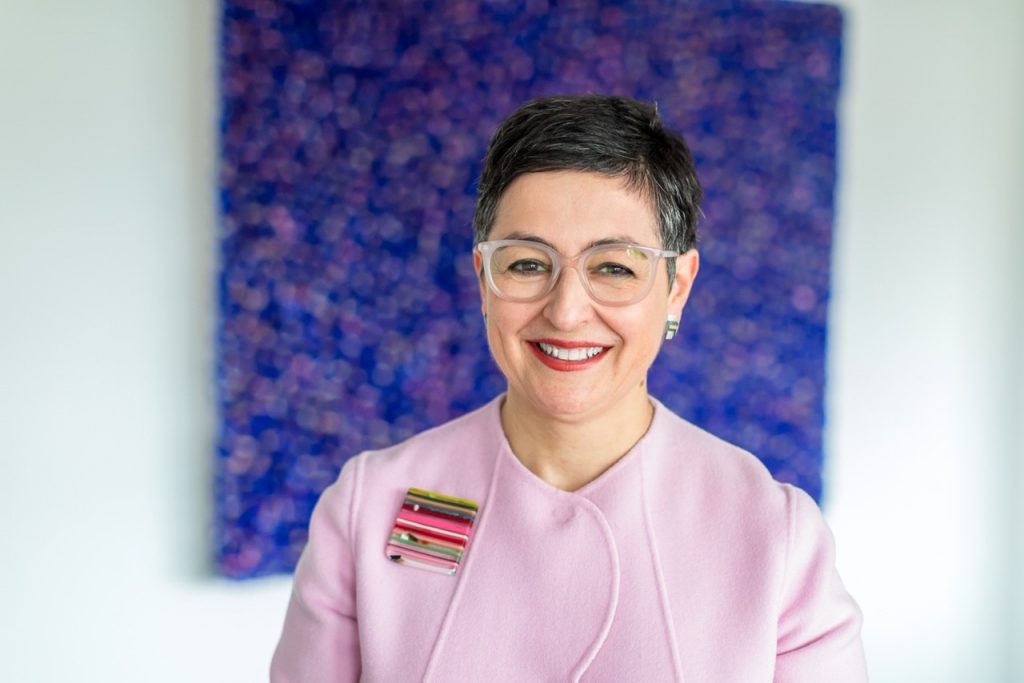
Photograph: Ms. Arancha Gonzalez (then ITC Executive Director) The Shridath Ramphal Centre for International Trade Law, Policy and Services of The University of the West Indies (the SRC) extends its warmest congratulations to former Executive Director of the International Trade Centre (ITC), Ms. Arancha Gonzalez, on her recent appointment to the position of Minister of Foreign Affairs for Spain. Ms. Gonzalez, who has a long track record in international trade, has been a tireless champion of trade for development, women’s issues and a friend to the Caribbean. Under Ms. Gonzalez’s tenure, the ITC has partnered with the SRC to promote our goals and support our work. The ITC remains one of the Geneva institutions visited by students of our Masters in International Trade Policy (MITP) programme during our annual Geneva Study Tour; continues to provide internship opportunities to our MITP students; and extends online access to its products such as Market Access Map. Just last year September, the SRC also partnered with the ITC to host in Barbados an all-female panel of women in trade, including Ms. Gonzalez. The panel was convened to discuss a publication co-edited by Ms. Gonzalez entitled ‘Women Shaping Global Economic Governance’. As the SRC wishes Ms. Gonzalez the very best in her future role, it also takes this opportunity to welcome new acting ITC Executive Director, Ms. Dorothy Tembo. We look forward to continuing the bonds of friendship between the SRC and the ITC.