


CCJ Advisory Opinion Endorses Differentiated Approach to Free Movement in CARICOM

Dr. Jan Yves Remy and Alicia Nicholls$*On 18 March 2020, the Caribbean Court of Justice (CCJ) delivered its first Advisory Opinion following a request filed a year ago by the Caribbean Community (the Community). It was asked to consider the legality of CARICOM Heads of Government’s decision allowing two Member States – Antigua and Barbuda and St. Kitts and Nevis – to opt out of an earlier decision to enlarge the list of skilled workers eligible to move and seek employment under the CARICOM Single Market and Economy (CSME).
The CCJ solicited and received written and oral submissions from interested parties, including counsel from the Community, CARICOM Member States, and…
Stay Safe during the COVID-19 outbreak
The SRC cares about your safety during this time and we will be back to normal operation as soon as we can. In the meantime, you can still contact us through our website, email or any staff. Also continue to look out for our research updates under the research and outreach tabs on our website.
CCJ Issues its First Advisory Opinion on Freedom of Movement

Caribbean Court of Justice: The Caribbean Court of Justice (CCJ)) on Wednesday last, provided its first advisory opinion concerning the interpretation and application of the Revised Treaty of Chaguaramas (RTC). The CARICOM Heads had requested the Court’s advice on two specific questions relating to freedom of movement within the Community. The questions concerned a decision by the Heads a) to enlarge the list of CARICOM workers who were entitled to seek employment in each other’s country by including agricultural workers and security guards (“the enlargement decision”) and b) to agree to the requests made by the states of Antigua and Barbuda and St Kitts and Nevis to opt out of that decision for a period of five years. The Court was asked to give its opinion on two issues: Firstly, whether a Member State could lawfully opt out of that decision of the Conference and Secondly, whether the principle of non-reciprocity would allow nationals of any such Member State opting out to gain the benefits of the decision. Read the full media release here. Read the full Advisory Opinion here and the summary here.
SRC and US Embassy Bridgetown host Lunchtime Chat on US-China-Caribbean Economic Relations
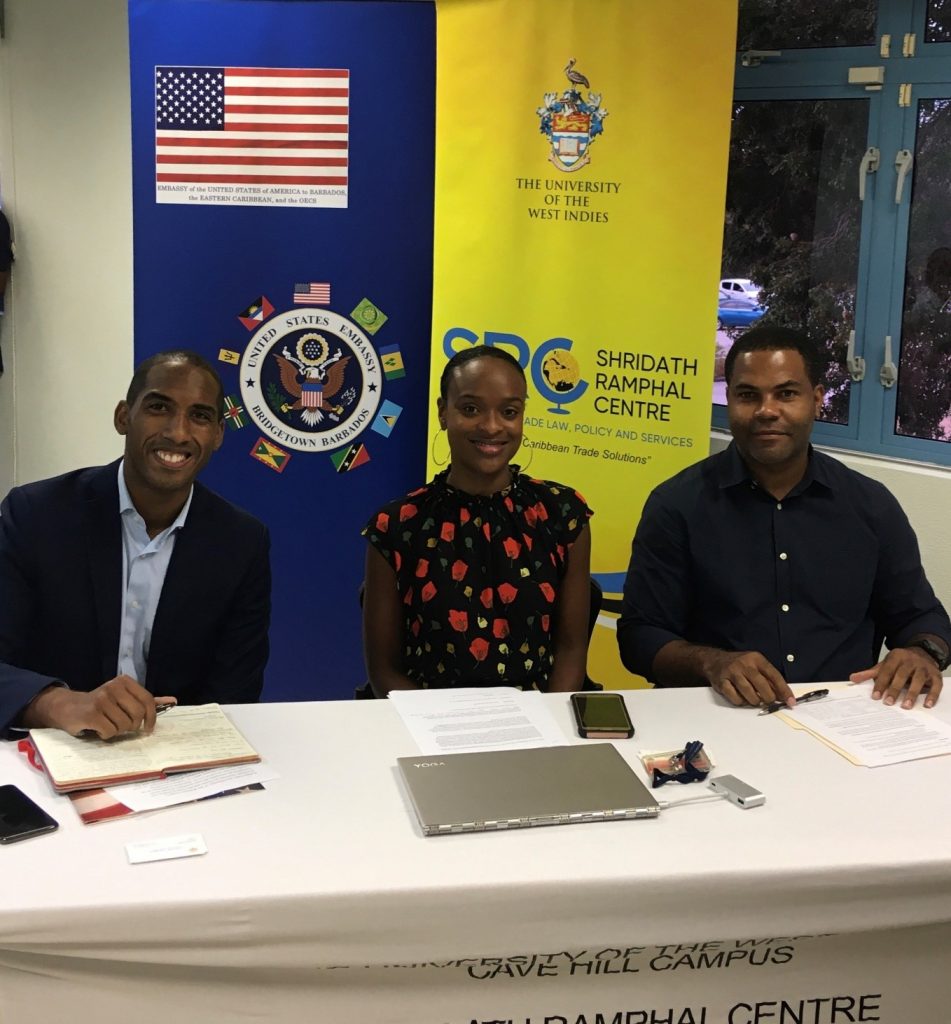
Caption: Mr. Leland Lazarus, Deputy Public Affairs Officer, U.S. Embassy (left), Dr. Jan Yves Remy, Deputy Director Shridath Ramphal Centre (middle), Dr. Antonio Alleyne, Lecturer in Economics, University of the West Indies Cave Hill Campus (right) BRIDGETOWN, Barbados – March 13, 2020 – On Friday 13 March, from 1 p.m. to 2:30 p.m., the Shridath Ramphal Centre for International Trade Law, Policy & Services (SRC) of The University of the West Indies (UWI), hosted one of its signature “SRC Lunch Time Chats”, this time in conjunction with the United States (US) Embassy, Bridgetown. The Chat focused on the impact on CARICOM of the Phase One US-China Trade Deal (the Deal) signed on January 15, 2020 between the world’s two top economies. After introductory remarks from the Chat’s moderator, Dr Jan Yves Remy (SRC Deputy Director), Mr. Leland Lazarus (Deputy Public Affairs Officer, US Embassy) introduced the featured speaker, Mr. Robert Daly (Director of the Wilson Centre’s Kissinger Institute on China and the United States). The audience, most of whom joined the Chat through live streaming, were treated to a detailed presentation by Daly on US – China relations preceding, and subsequent to, the signing of the Deal. That Deal, which comes amidst escalating tensions between the US and China, is unique in a number of respects and notably commits China to USD 200 billion worth of imports in an effort to decrease the gaping US trade deficit. Mr. Daly noted that while there was hope that the signed agreement would restore certainty to markets and de-escalate tensions, in his view, it represented no more than a “pause”. That said, he credited US President Donald Trump with bringing greater awareness to critical issues in the US-China economic relations, highlighting that, unlike his predecessors, President Trump had demonstrated success in applying unprecedented pressure to China. China could also boast a ‘win’ since the Deal could be seen as a commitment by the Trump Administration to begin a dialogue and a “phased approach” towards ongoing negotiations with China. Daly also stated that other issues may hinder further progress to a Phase Two Deal, such as China’s subsidies of its state-owned enterprises, human rights abuses in areas such as Xinjiang, and attempts by China to spread its 5G technology globally. Following Daly’s presentation, the discussant, Dr. Antonio Alleyne (UWI Lecturer in Economics Department) contextualized the deal’s implications for the Caribbean. Dr. Alleyne noted that the Caribbean would suffer minimal losses from the Deal due to the Caribbean’s trade divergence in favour of the US over China, as indicated by initial data. That said, he expressed hope that in the future, the Caribbean would increase its exports to China. Dr. Alleyne also questioned the Deal’s compatibility with the rules of the World Trade Organization (WTO), highlighting that continued weakening of the multilateral system would have negative implications for small developing countries within CARICOM. During the question and answer session, topics ranged from the impact of the Deal on the Belt and Road Initiatives being pursued by China in some Caribbean countries, to how Caribbean small states should position themselves geo-politically between two hegemons that pursue vastly different ideological approaches in their global relations. In their remarks, Mr. Daly and Dr. Alleyne both took note of COVID-19’s likely disruptive effects on trade among the US, China and the Caribbean, and in their respective relations in the global economy at large. WATCH the video recording of this and other SRC Lunch Time Chats by accessing our video gallery here.
UPDATED: COVID 19 and Trade – SRC Trade Quick Guide
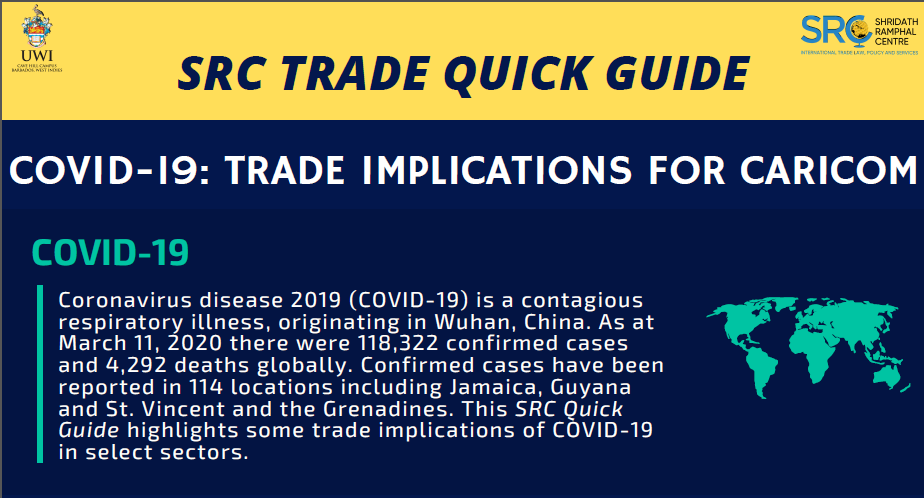
Our latest SRC Trade Quick Guide prepared by our trade researcher, Ms. Chelceé Brathwaite, looks at the possible trade impacts of COVID-19 on the Caribbean. Access the full UPDATED infographic by clicking here.
The SRC’s Newsletter for March 2020 is out!

Our SRC Newsletter for March 2020 is now out! In this edition, we discuss the possible trade impact of COVID-19 for the Caribbean, our new OECS-MITP programme, whether Caribbean countries should join the WTO Investment Facilitation for Development negotiations and our upcoming events, among others! Have a read here: https://mailchi.mp/022fade9bb24/src-newsletter-march-2020?e=d10638797c
A WTO Investment Facilitation Agreement: Any added value for the Caribbean?

Alicia Nicholls$*The majority of World Trade Organization (WTO) Members have this month commenced negotiations to conclude a binding multilateral agreement on investment facilitation for development. The negotiations, which have received the support of the global business community, seek to facilitate investment flows between economies in a sustainable and pro-development manner. To date, one hundred WTO Members, including four CARICOM Member States, have endorsed the Joint Statement Initiative on Investment Facilitation for Development. Essentially, Member States will be negotiating the investment equivalent of the Trade Facilitation Agreement (TFA).
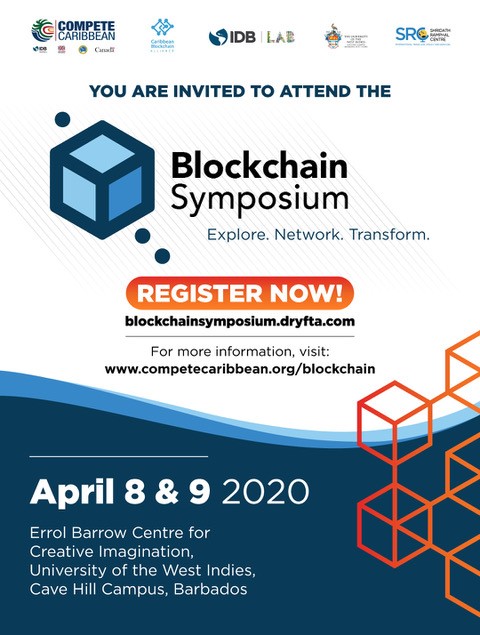
SRC/IDB Blockchain Symposium
SRC-US Embassy Lunch Time Chat on US-China Deal
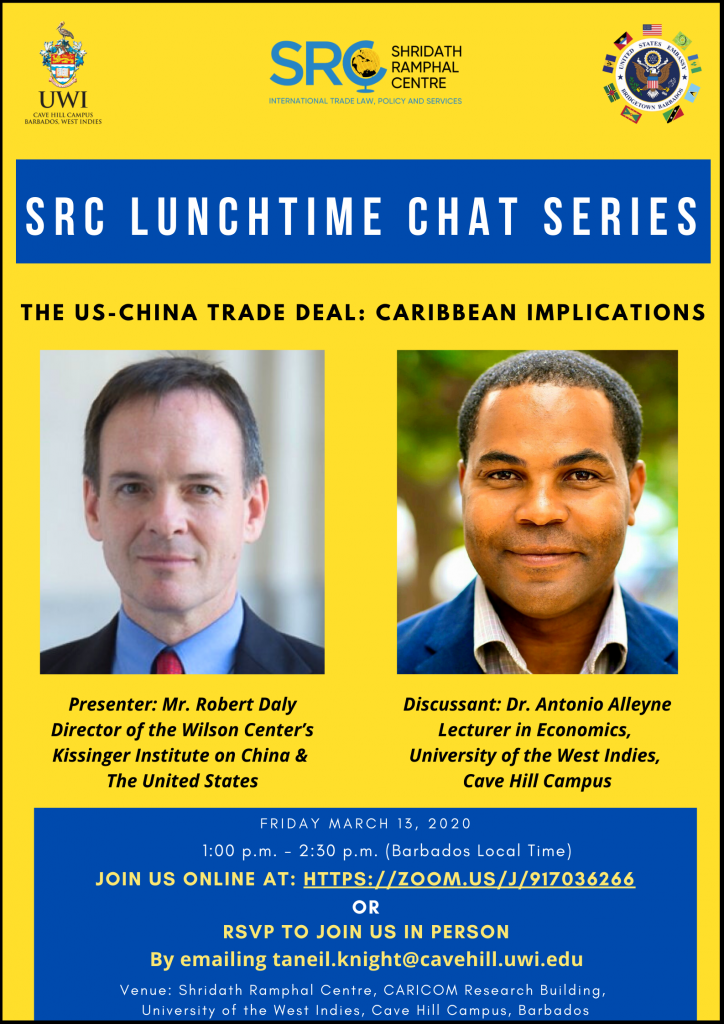
Join the SRC and the US Embassy on March 13 for our upcoming joint Lunch Time Chat on the US-China Deal and the implications for the Caribbean.
SRC welcomes 22 new students under fully-funded OECS Masters in Trade Programme
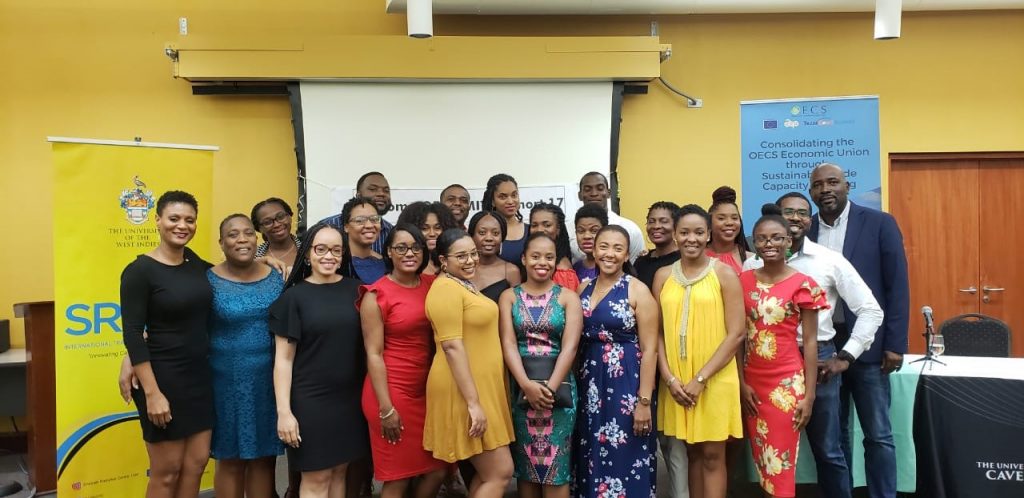
In photo: Students of the new OECS-MITP programme with two staff members of the OECS Commission Ms. Shameilla Moses and Mr. Winsbert Louison at extreme left and back right of students, respectively. BRIDGETOWN, Barbados – March 2, 2020 – The Shridath Ramphal Centre for International Trade Law, Policy & Services (SRC) of The University of the West Indies (UWI) last week welcomed twenty-two new students under a special dispensation of its flagship Masters in International Trade Policy (MITP) Programme, created through collaboration between the SRC and the Commission of the Organisation of Eastern Caribbean States (OECS), and tailored to the needs of OECS nationals. The students are beneficiaries of a fully-funded scholarship made possible by the European Union (EU) through its TradeCom II Project – Building ACP Trade Capacity. The OECS-MITP Programme will end in March 2021. The scholarship recipients, who hail from across the OECS territories, were formally welcomed at a reception held in their honour on Friday, February 28th at the Sagicor Cave Hill School of Business. The reception was attended by officials from the OECS Commission, Senior University Administrative staff and faculty, current students and alumni of the MITP programme. In his official welcome, SRC Director Neil Paul highlighted the feat of the regular MITP in training over 200 students from across the Caribbean. He referred to studies showing that MITP graduates have found employment not just in the highest levels of government, foreign embassies and regional and international organisations, but also in the private sector. Deputy Principal of The UWI Cave Hill Campus, Professor Winston Moore, explained that the OECS-MITP Programme fits within current initiatives of the UWI, focused on offering specialized training. The Programme is backed by the name and brand of The UWI, which ranks among the top 4% of universities in the world and top 2% in the Latin America and Caribbean region. Project Manager of the ACP TradeCom II Project with the OECS Commission, Mr. Winsbert Louison, urged the recipients to take advantage of the opportunity, and looked forward to their contributions in furthering the mandate of the OECS Commission in expanding the OECS’ trade capacity and solidifying their economic union. Delivering the evening’s keynote address entitled “The Place of the OECS in a Changing World”, Dr. Wendy Grenade, OECS-MITP Faculty Member, and Head of the Department of Government, Sociology, Social Work and Psychology of The UWI Cave Hill Campus, gave inspiration to the new students. She reiterated that they were joining a tradition of excellence at the University of the West Indies, where “one flies and all soar”. Dr. Grenade divided her address into two parts: the first explored the historical journey of the OECS, and the second considered implications for the OECS small states in a new world. She cautioned the students to be philosophically grounded as they engage the multilateral system, and encouraged them to pursue trade policy conscientiously, and with an understanding of the machinations of global geopolitics. Replying on behalf of the new students, Ms. Leah Crag-Chaderton expressed the group’s thanks, quipping that while they had all come on ‘different ships’, they were all now in the “same boat”. The evening closed with a cocktail reception.