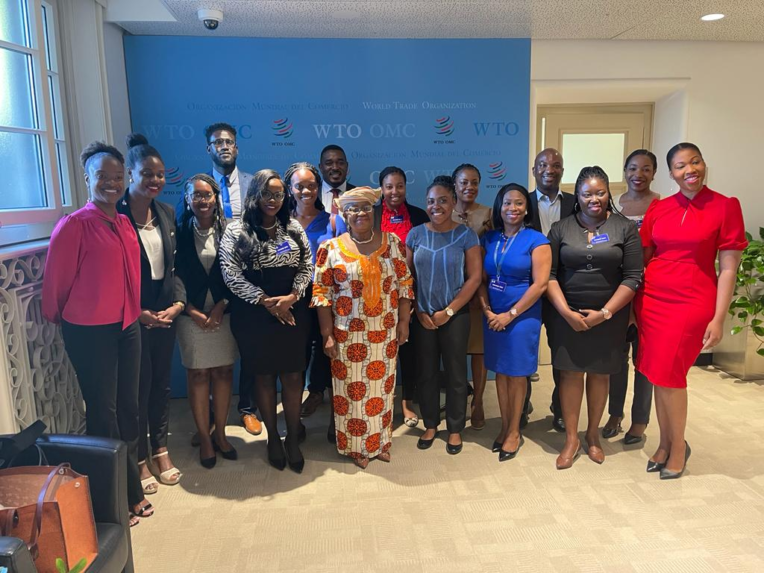
Pursuing the Masters in International Trade Policy offered by the Shridath Ramphal Centre for International Trade Law, Policy and Services at the University of the West Indies Cave Hill Campus was definitely a great idea, and certainly one of my best life decisions to date. However, adding the study tour to Geneva so that students can see first hand what was taught in the classroom was sheer genius.
During our recent tour to Geneva, the importance of the World Trade Organisation (WTO) was reinforced, as well as its central contribution to global and economic governance.
We learned before the study tour that the WTO and all of its related organisations, such as the World Intellectual Property Organization (WIPO) and the International Trade Centre (ITC), are critical because they help to promote and effectuate international trade. We also learned that the WTO provides an important avenue for governments to negotiate trade agreements and also aid in the resolution of trade disputes. Furthermore, we learned about the role of the WTO in supplying governments with assistance and guidance in the form of technical assistance on trade-related issues.
Our trip to Geneva reinvigorated our interest and passion for international trade law. In Geneva, we were repeatedly reminded that the WTO, which was established in 1995, is the lone international organization in charge of overseeing the laws that govern international trade. The WTO today has 164 members, with an additional 25 countries negotiating membership. We were also reminded that the WTO’s primary function is to ensure that trade flows as smoothly, predictably, and freely as possible, which it accomplishes by administering trade agreements, serving as a forum for trade negotiations, resolving trade disputes, reviewing national trade policies, developing economies’ trade capacity, and cooperating with other international organisations. We developed a further appreciation of the fact that the WTO agreements are central to almost every aspect of global trade. WTO agreements and norms tend to make policy more predictable while discouraging protectionism.
The WTO is critical to the world’s smallest and most vulnerable economies like ours in the Caribbean. Market access, which opens up a world of economic opportunities, is vital to the development of our countries.
We were also reminded that the WTO brings consistency and certainty to the international trading system. Countries like ours, despite our small size, can trade with other countries without fear of being subjected to arbitrary or unfair measures. Indeed, the dispute resolution process helps to ensure that these countries can defend themselves using treaty rules, and thereby challenge unfair or illegal trading activities.
In Geneva, we obtained important information on WTO processes. More particularly, we were informed that, before an agreement can be achieved, each country must be persuaded or come to a compromise. Whatever is ultimately presented must be refined until it is acceptable to everyone, or more specifically, until no one objects. Following that, all countries must follow the agreed rules. Developing and least developed countries are sometimes granted exceptions, delays, or flexibilities, but the rules remain the same.
The Geneva tour helped to reinforce the point that consensus decision-making, coalition building, and agreed-upon regulations all help to diminish the disparities in bargaining power. Coalitions give developing nations a more powerful negotiating position. For instance, St. Vincent and the Grenadines (SVG) putting forward a proposal may be seen as insignificant, but SVG is a part of the Organisation of the Eastern Caribbean states, which has six members, as well as CARICOM, which has 15 members and the African, Caribbean, Pacific (ACP) group, which is 79 members strong. In most cases, where trade related matters are concerned, these nations’ interests align.
Our travel to Geneva allowed us to observe the proceedings of various CARICOM Missions, as well as the OECS Mission. This gave us the unique opportunity to observe bilateral and multilateral negotiations firsthand. Regardless of the geopolitics involved, our Ambassadors and officers are truly punching above their weight.
It was very refreshing to hear such strong commendation for our region’s leaders especially for their involvement in the recently concluded twelfth Ministerial Conference of the WTO, namely Senator Dr. The Most Hon. Jerome Walcott, Minister of Foreign Affairs and Foreign Trade in Barbados, who served as Vice Chairperson; Hon. Kiesal Peters, Minister of State in charge of Foreign Affairs and Foreign Trade in SVG, who ably represented the OECS and spearheaded the E-commerce discussions; and Ms. Kerrlene Clairwel Wills of the Co-operative Republic of Guyana’s Permanent Mission to the United Nations Office and other international organisations in Geneva who facilitated the negotiations on fisheries, which are vital to the region since our region is made up of more water than land. Furthermore, it represents the livelihoods of many families in the Caribbean.
The outcomes and decisions of MC12 clearly demonstrate the need for the WTO. Having our leaders at the forefront of the process undoubtedly amplified the voice of our region. Clearly, the numerous missions are both successful and influential, even with minimal resources, both human and otherwise. It, however, remains to be seen how much more can be accomplished if additional resources are put into the missions.
Remorno Hamilton is a student in the Masters of International Trade Policy Programme of the Shridath Ramphal Centre of the University of the West Indies, Cave Hill. Learn more about the SRC at www.shridathramphalcentre.com.