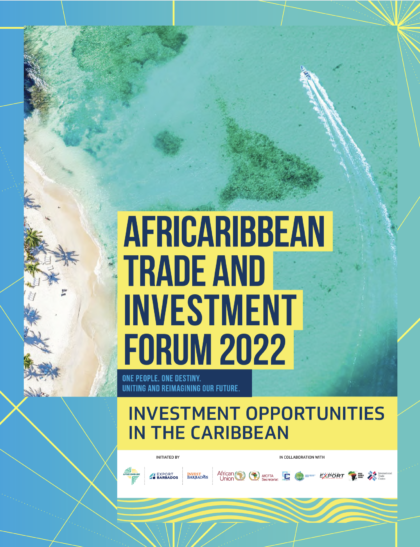
When the curtain fell last week on the inaugural Afri-Caribbean Trade and Investment Forum (ACTIF) 2022 hosted jointly by the Afri-Eximbank and the Government of Barbados, spirits were riding high. The three-day conference held in Barbados under the theme “One People. One Destiny. Uniting and Reimagining Our Future”, was hailed as a grand success in strengthening trade and investment relations between the private sectors of Africa and the Caribbean.
In attendance at ACTIF were African and CARICOM heads of governments and business organizations; and over 2000 persons from the private sector, educational institutions and government entities registered for the event. A specially chartered flight from Lagos Nigeria direct to Barbados brought over 120 African participants to participate in the joint exhibitions, cultural events and high-level speaking and panel sessions over the three days.
But having signed memoranda, declared grand intentions and issued a Joint Communique, many left ACTIF wondering what our leaders really achieved: what were the tangible gains made, and where do we go from here?
Where do we go from here?
These questions fell to my panel – the last session at the ACTIF (2022) – for consideration. Entitled Building Africa-Caribbean Value Chains for Exports: Imagining Caribbean – Africa Free Trade Area Agreement, our seven-person panel – comprising representatives from regional Secretariats, the private sector, and academics – was tasked with exploring how Africa and the Caribbean should build on the CARICOM-Africa Summit held in September 2021 and ACTIF 2022; and examine the prospects for an Africa-Caribbean Free Trade Agreement. After a 45-minute discussion, the consensus of my panel was clear: while our leaders’ ambitions were laudable, there is little appetite – or capacity – at this stage to enter a full-scale trade Agreement between our two regions.
My own view was that, like ballast to a ship, the highfalutin intentions need grounding in a structured and coherent ecosystem and process, so that the passage can be smooth and stead. I made three main points in this regard.
First, and to the bemusement of my business-minded co-panelists, I reiterated that ideas and models matter. Propitious estimates by the ITC that the export potential of trade between the Caribbean and Africa is $1 billion; or by the World Bank that African integration would see a $450 billion increase in GDP by 2035; or by the IMF that regional integration in CARICOM would generate welfare enhancement of over $6 billion holds no real promise unless we can achieve structural transformation in each of our regions. Africa’s thinking, scholarship, and ambition under the Africa Continental Free Trade Agreement (AfCFTA) has engrained a new development-friendly, sustainable and inclusive approach to trade. It embeds the counternarrative to trade liberalism, through its focus not singularly on liberalizing goods and services, but privileging capacity building, and the participation of women, small businesses, youth, digital economy, investment, and the free movement of persons. These are also areas that CARICOM, under its CSME, cares about. Together, Africa and the Caribbean must use their voices to bring to centre-stage these approaches to trade, and our collective solutions to global challenges of debt financing, climate change and food security.
Second, I reiterated that if we are to take meaningful steps toward integration, we must prioritize and structure the process for doing so. We had to consider and answer questions like: what sectors should we begin with? Do we start with the big or smaller companies? Should we engage at the bilateral, state-to-state level or should our respective Community Secretariats lead? Should decisions be made on a consensus basis or can some move earlier than others through “enhanced cooperation”? How do we overcome the implementation paralysis of both regions? Should we join each other’s integration processes as observers or associate members? How do we resolve disputes?
These questions led to my third and final point which was a recommendation to create a High-Level Committee, answerable to Heads of African and CARICOM states, to frame the process for integrating our regions. Such a Committee would comprise the right mix of business persons, academia, young leaders, women, civil society and regional secretariats, who would be tasked with proposing an effective approach and process for advancing the economic relationship between our regions. Importantly, the Committee’s work would not displace organic synergies that are already happening between African and Caribbean stakeholders – for instance, joint endeavours between the private sectors or Secretariats in the respective regions. Rather, it would facilitate, embed and guide these processes, and provide accountability that would make them sustainable over the long run.
Sailing towards a common destiny
Africa and the Caribbean’s structural transformation through economic integration is a worthwhile pursuit. But to move forward, the immediate focus must be on cementing our own regional projects, with efforts to integrate at the wider level being well-conceived, structured and complementary. In the poignant but chilling words of one of my fellow panelists, it cannot be that centuries ago, our people were shipped as human cargo across the Atlantic, and today, we cannot ship our goods to each other. It is true that a common destiny awaits us, but in the interim, we need deft captains and crew to get us there.
Dr. Jan Yves Remy is the Director of the Shridath Ramphal Centre for International Trade Law, Policy and Services (SRC), UWI. For more information about the SRC, visit our website at: www.shridathramphalcentre.com